


Deliver fast, reliable service with a cloud system that updates in real-time and scales with your business.

Control your data and infrastructure with a secure, offline-ready solution tailored for complex environments.

Empower customers to check in, book, or update their appointments without staff assistance.

Deliver fast, secure access for repeat visitors using AI-powered facial recognition.
 Banking
Streamline customer flow and reduce wait times in banks and financial institutions.
 Healthcare
Refine patient check-ins and improve healthcare service.
 Public
Sector
Public
Sector
Manage citizen services smoothly in government offices and public institutions.
 Retail
Improve shopping experiences by minimizing checkout lines and wait times.
 DMV
DMV
Organize customer service queues in automotive showrooms and service centers.
 Airport
Speed up passenger processing with efficient queue management at terminals.
All Industries → AI Appointment Booking System
Automate appointment scheduling with AI-powered booking, smart reminders, and seamless customer check-ins.
 Appointment
Booking
Appointment
Booking
Offer flexible scheduling that helps customers plan their visit and avoid peak-time congestion.
 Biometric
System
Biometric
System
Speed up identity verification and check-ins using facial or fingerprint recognition.
 Automation
Automate workflows and reduce manual tasks with smart queue solutions.
 Virtual
Queuing
Virtual
Queuing
Let customers wait from anywhere home, car, or cafe with mobile-based virtual queues.
 Visitor
Management
Visitor
Management
Track and manage visitor entry, exit, and ID verification from a single dashboard.
 Video
Queue
Video
Queue
Allow people to join video calls instantly with one link—no apps, Accessible on any browser.
 Tele-Consultation
Offer seamless virtual consultations with real-time communication tool.
All Solutions →
Watch quick product demos and tutorials to understand how Qwaiting works for your business.

Read expert insights, tips, and industry trends to enhance customer experience.

Download in-depth guides and resources to explore queue management best practices.

Explore Qwaiting in a quick interactive demo, no signup needed.
GPS technology offers visibility into the locations while telematics provides performance analytics. But, knowing where vehicles are does not manage their movement. Modern flow software combines queue and fleet data to predict when trucks will move. It assigns docks before arrival, transforming passive monitoring into active operational control.
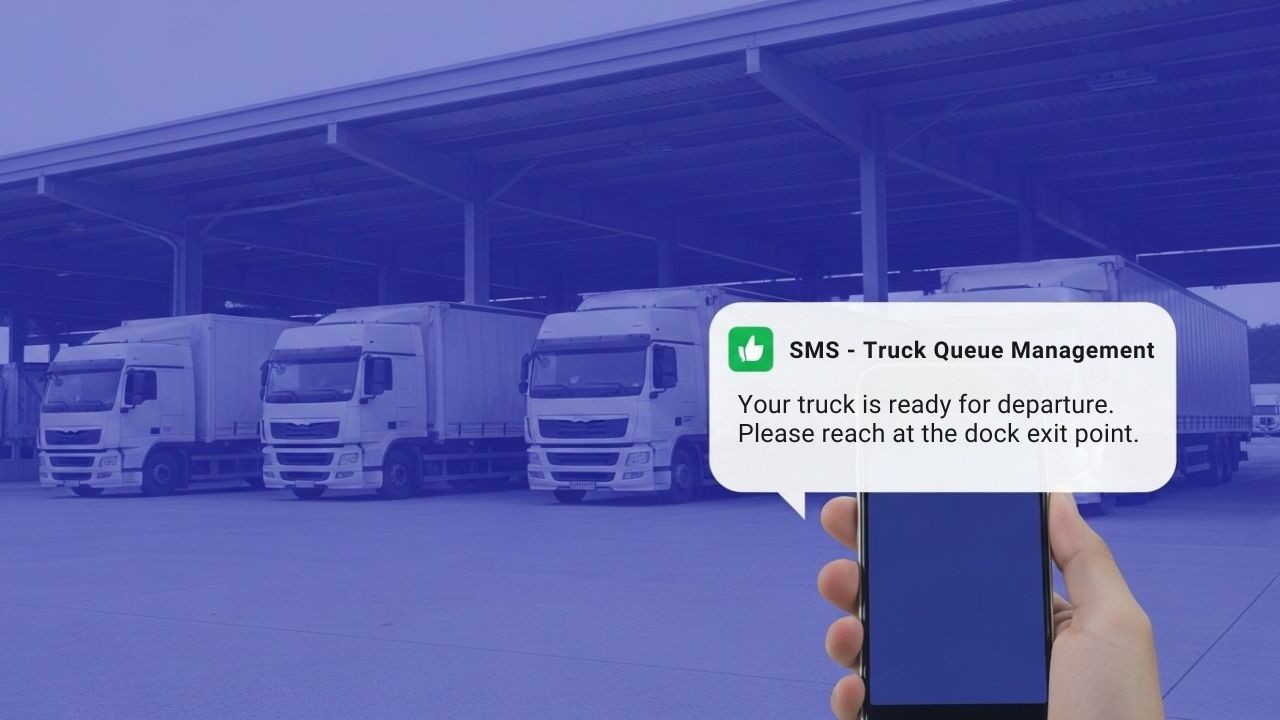
Queue management systems assign arriving trucks to available loading bays in fleet systems. For example, if a truck is 15 minutes away, it can go with a dock that will be free in 12 minutes. Drivers receive complete directions to their assigned bays. Loading crews get prior information what to do next. This allows vehicles to move from the gate to the dock without using radios or causing traffic.
Reduced congestion and streamlined processes have sped up truck turnaround time. Faster loading allows each truck to make more deliveries daily, maximizing fleet efficiency. Optimized truck usage increases capacity, eliminating new investment needs. As a result, there is a direct improvement in revenue per vehicle.
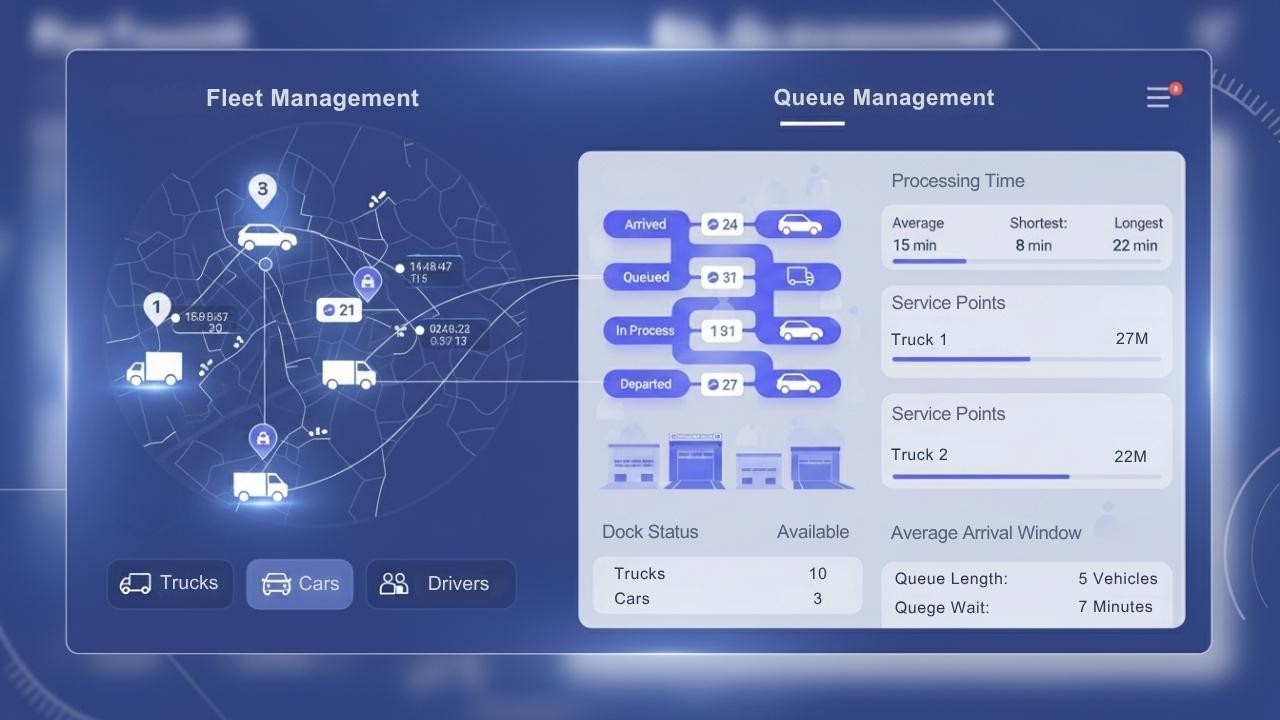

KPIs logistic firms noticed using Qwaiting’s smart queue management system for logistics.
| KPI | Result with Qwaiting |
| Avg. gate time | ↓ 35% |
| Fleet utilization | ↑ 25% |
| Operational costs | ↓ 20% |
| Driver satisfaction | ↑ 40% |
Discover 9 predictions that reveal what queue management will look like by 2030.
Queue management streamlines vehicle entry, dock assignments, and loading schedules. By automating check-ins and coordinating arrivals, it minimizes gate congestion, ensuring trucks spend more time moving and less time waiting.
Integration connects fleet tracking with real-time facility data, enabling synchronized scheduling, predictive routing, and faster dock turnovers. This reduces delays, maximizes truck utilization, and transforms logistics from reactive to proactive operations.
Real-time data offers complete visibility into fleet locations, dock status, and facility flow. It helps logistics teams make faster, informed decisions, prevent bottlenecks, and maintain uninterrupted movement across the supply chain.
Key metrics like gate processing time, asset utilization, fuel efficiency, and driver satisfaction significantly improve. The integration drives measurable gains, faster throughput, lower operational costs, and improved overall fleet productivity.
Absolutely. Qwaiting’s scalable architecture supports single depots to global networks. It standardizes operations, connects data across locations, and delivers consistent performance, ensuring seamless coordination across continents and complex logistics ecosystems.