


Deliver fast, reliable service with a cloud system that updates in real-time and scales with your business.

Control your data and infrastructure with a secure, offline-ready solution tailored for complex environments.

Empower customers to check in, book, or update their appointments without staff assistance.

Deliver fast, secure access for repeat visitors using AI-powered facial recognition.
 Banking
Streamline customer flow and reduce wait times in banks and financial institutions.
 Healthcare
Refine patient check-ins and improve healthcare service.
 Public
Sector
Public
Sector
Manage citizen services smoothly in government offices and public institutions.
 Retail
Improve shopping experiences by minimizing checkout lines and wait times.
 DMV
DMV
Organize customer service queues in automotive showrooms and service centers.
 Airport
Speed up passenger processing with efficient queue management at terminals.
All Industries → AI Chatbot
Intelligent conversational AI that answers questions, books appointments, and assists 24/7.
 AI Appointment Booking System
Automate appointment scheduling with AI-powered booking, smart reminders, and seamless customer check-ins.
 Appointment
Booking
Appointment
Booking
Offer flexible scheduling that helps customers plan their visit and avoid peak-time congestion.
 Biometric
System
Biometric
System
Speed up identity verification and check-ins using facial or fingerprint recognition.
 Automation
Automate workflows and reduce manual tasks with smart queue solutions.
 Virtual
Queuing
Virtual
Queuing
Let customers wait from anywhere home, car, or cafe with mobile-based virtual queues.
 Visitor
Management
Visitor
Management
Track and manage visitor entry, exit, and ID verification from a single dashboard.
 Video
Queue
Video
Queue
Allow people to join video calls instantly with one link—no apps, Accessible on any browser.
 Tele-Consultation
Offer seamless virtual consultations with real-time communication tool.
All Solutions → Become a Partner
Start your Qwaiting partner journey.
 Reseller Partner
Program
Reseller Partner
Program
Unlock new revenue by reselling Qwaiting solutions.
 Become a Sales Partner
Turn customer relationships into new revenue opportunities.
 Become a Development Partner
Build smarter customer journeys by connecting your technology.
 Become a Hardware Partner
Bring your devices, kiosks, and displays into connected customer flow.
Explainer
Videos
Watch quick product demos and tutorials to understand how Qwaiting works for your business.
 Blog
Blog
Read expert insights, tips, and industry trends to enhance customer experience.
 Ebooks
Download in-depth guides and resources to explore queue management best practices.
 Self Guided
Demo
Self Guided
Demo
Explore Qwaiting in a quick interactive demo, no signup needed.
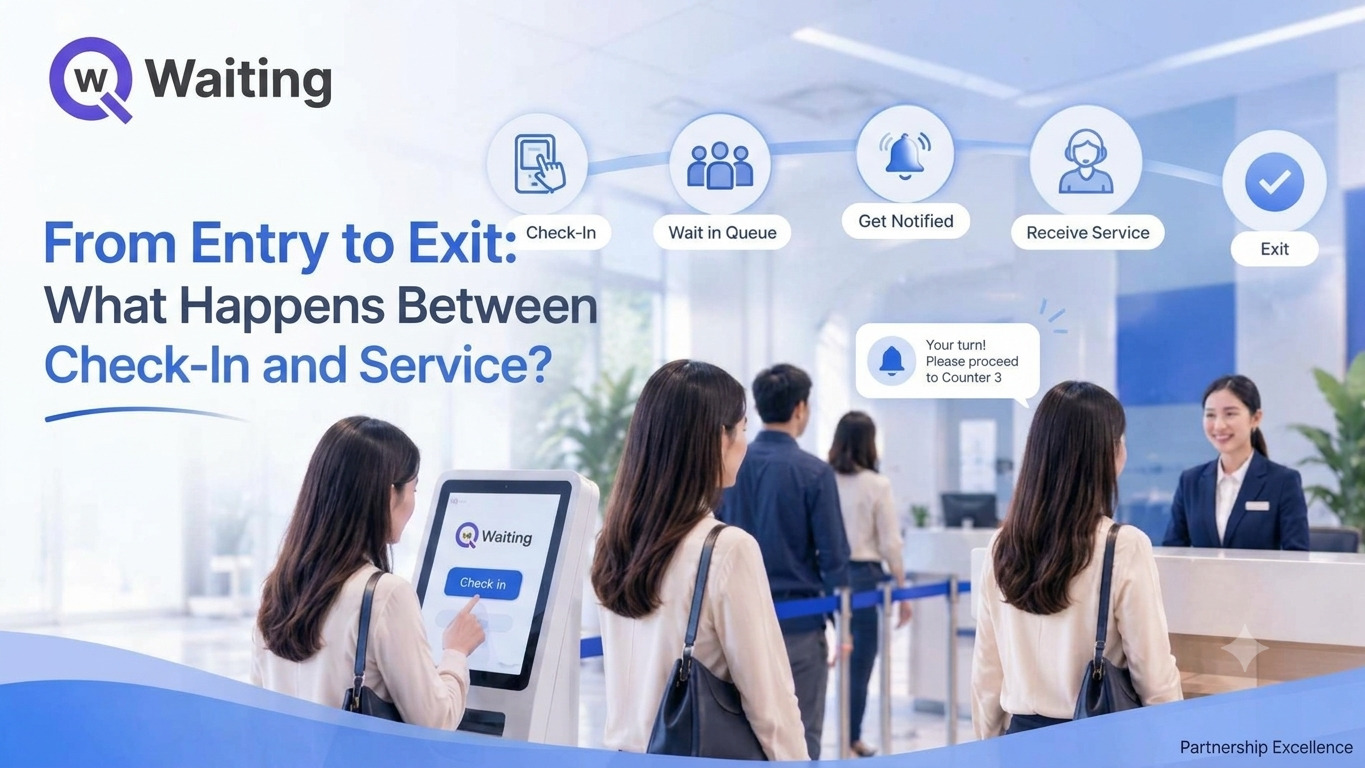
Discover how businesses can improve the customer journey from entry to exit by connecting check-in, queue management, service routing, real-time notifications, and analytics with Qwaiting.
A woman walks into a clinic, taps a kiosk, and she’s checked in before she’s even put her phone away. Great. Then she stands there. Nobody tells her which room is hers, or whether she’s next, or whether “next” means five minutes or fifty. So she does what most of us would do and walks back to the front desk, where a small line of people with the same questions has already formed.
Her check-in took under a minute. Her visit still went badly.
Most businesses would look at that clinic’s numbers and call it a win. Short wait, fast registration, healthy dashboard. The customer saw something else.
So the question isn’t really “how long do people wait?” It deals with managing the waiting process or even the whole process of the customer through entry and exit. Those are different jobs. The end-to-end customer journey begins at the door, well before anyone reaches a counter.
A short queue can still hide a bad visit. Here’s why a line and a journey aren’t the same thing.
A queue is a line of people. A journey is everything those people go through between walking in and walking out. The former you would be able to manage, but the latter may spell disaster.
Consider how insignificant the problems are. A sign that leads you to the wrong floor, a clerk at check-in uses one list, and the clerk at the counter uses a different one, and the customer walks up to the counter to discover that nobody had been expecting them. It’s not an exciting scenario. Stack three of them in one visit, though, and the whole thing feels clumsy.
People will wait if they know what’s going on. What wears them down is the not knowing. Ten silent minutes feel longer than ten minutes with a text that says “you’re fourth.”
That’s why customer flow from entry to exit deserves its own attention, separate from queue length.
Every visit passes through the same stages. Here’s what customers experience at each one and what your team manages.
The customer enters the store and has only one thought: where do I start? If the answer isn’t obvious, you get a crowd at the door before the visit has even started.
Desk, kiosk, QR code, appointment check-in, whatever you use. The only goal is to collect what you need without creating a second line behind the first.
This is where people get sent to the right service, department, or staff member. Get it right, and nobody fills in the same form twice. Get it wrong, and someone walks across the building for nothing.
Customers should know where to wait and roughly when they’ll be called. A text or WhatsApp message does more than most businesses expect, because it takes the guessing away.
Staff take the next person, knowing who they are and what they came for. And here is where there is an actual limitation on the capacity of the front-end process. If you’re short-staffed, no amount of clever routing hides it.
The customer gets clear next steps and leaves. They shouldn’t have to loop back to reception, or come back tomorrow because something wasn’t explained.

Notice the loop. Visits rarely run in a straight line. A patient goes from consultation to billing. A shopper goes from the sales desk to returns. Those handoffs matter as much as the first queue, and they’re usually the part nobody owns.
Fast queues can sit on top of slow visits. These five friction points turn up in most busy service locations.
Paper forms and retyped details slow the very first step, and the delay carries through everything after it.
Customers don’t know their status, where to go next, or when to come back. So they ask staff, and the delay slows the staff down, which makes the line longer.
One wrong counter and the customer starts again. It costs them time and costs your team patience.
One counter is buried while the one next to it sits quiet. Customers see this. They always see this.
Plenty of businesses track wait time and stop there. The minutes spent moving between services, sorting out problems, or finishing up never show up in a report.
Good visitor flow management needs a view of the whole process, not a headcount of the line.
Qwaiting has published a customer story that shows these ideas in a working environment. Here’s how the pieces fit together.
Imagine any learning or training centre. Visitors arrive for different services. Some have bookings, some just walk in. Check-in gets crowded, people aren’t sure where to go, and staff keep track of arrivals by hand. These are common problems in that kind of setting. They’re general observations, not a record of what NTUC LearningHub faced.
In the published story, the stages work together:
A visitor arrives for a booked or walk-in service
They check in and join the right queue
Queue status is visible to staff and visitors
Staff manage the flow with a clearer view of demand
The visitor is served, and the visit wraps up
The story is an indication of quick self-checking in, quick visibility of queues, better management of staffing, less time waiting around, and a better experience. It is great to have a quick check-in process but it would be much better if you had a process that incorporates everything else too.
Most tools fix one stage. A connected journey needs one view across all of them. This is how Qwaiting approaches it.
Appointment booking lets you plan for scheduled visits alongside walk-ins.
Self-service and QR check-in make it easy for people to get into the process.
Queue management and routing send each person to the right service point.
SMS and WhatsApp notifications tell customers when their turn is getting close.
Digital signage provides information regarding queues and directs customers to the correct counter.
Real-time analytics track wait times, service times, staff performance, and bottlenecks.
If teams can identify where the bottlenecks occur, then they can take action on them. Admin can staff their counters based on actual demand and not assumptions. They figure out what process is holding up the work and then address it organization-wide rather than only at the branch complaining the most.
Qwaiting allows organizations to manage the entire customer process from check-in and queuing through service provision.
You can’t fix what you only half measure. Start with these five numbers, and you’ll see the whole visit more clearly.
Total visit duration: from start to finish, not just waiting for their turn in line.
Check-in time: the speed at which people can join the queue.
Routing and transition time: the amount of time between registration, assignment to a queue, and reaching the counter.
Service time and staff utilization: when there is not enough capacity or when workloads are unevenly distributed.
Customer satisfaction: whether customers felt informed, guided, and well served.
One caution. Total visit duration is a broader operational view. What gets captured automatically depends on how your setup is configured, so some steps may need sampling or manual tracking.
Issues can be faced by customers at any stage, even where the actual service is fast. Arrival, check-in, routing, communication, service delivery, and departure all define how a visit was. If you treat each as an independent issue, you'll always end up putting effort in the wrong place.
Therefore, an interesting question for you.
What process on your customer journey map shows your greatest operational challenge?
We’d like to hear your answer in the comments. And if you want to see how your own customer flow could improve, the Qwaiting team is happy to talk it through.