


Deliver fast, reliable service with a cloud system that updates in real-time and scales with your business.

Control your data and infrastructure with a secure, offline-ready solution tailored for complex environments.

Empower customers to check in, book, or update their appointments without staff assistance.

Deliver fast, secure access for repeat visitors using AI-powered facial recognition.
 Banking
Streamline customer flow and reduce wait times in banks and financial institutions.
 Healthcare
Refine patient check-ins and improve healthcare service.
 Public
Sector
Public
Sector
Manage citizen services smoothly in government offices and public institutions.
 Retail
Improve shopping experiences by minimizing checkout lines and wait times.
 DMV
DMV
Organize customer service queues in automotive showrooms and service centers.
 Airport
Speed up passenger processing with efficient queue management at terminals.
All Industries → AI Appointment Booking System
Automate appointment scheduling with AI-powered booking, smart reminders, and seamless customer check-ins.
 Appointment
Booking
Appointment
Booking
Offer flexible scheduling that helps customers plan their visit and avoid peak-time congestion.
 Biometric
System
Biometric
System
Speed up identity verification and check-ins using facial or fingerprint recognition.
 Automation
Automate workflows and reduce manual tasks with smart queue solutions.
 Virtual
Queuing
Virtual
Queuing
Let customers wait from anywhere home, car, or cafe with mobile-based virtual queues.
 Visitor
Management
Visitor
Management
Track and manage visitor entry, exit, and ID verification from a single dashboard.
 Video
Queue
Video
Queue
Allow people to join video calls instantly with one link—no apps, Accessible on any browser.
 Tele-Consultation
Offer seamless virtual consultations with real-time communication tool.
All Solutions →
Explainer
Videos
Watch quick product demos and tutorials to understand how Qwaiting works for your business.
 Blog
Blog
Read expert insights, tips, and industry trends to enhance customer experience.
 Ebooks
Download in-depth guides and resources to explore queue management best practices.
 Self Guided
Demo
Self Guided
Demo
Explore Qwaiting in a quick interactive demo, no signup needed.
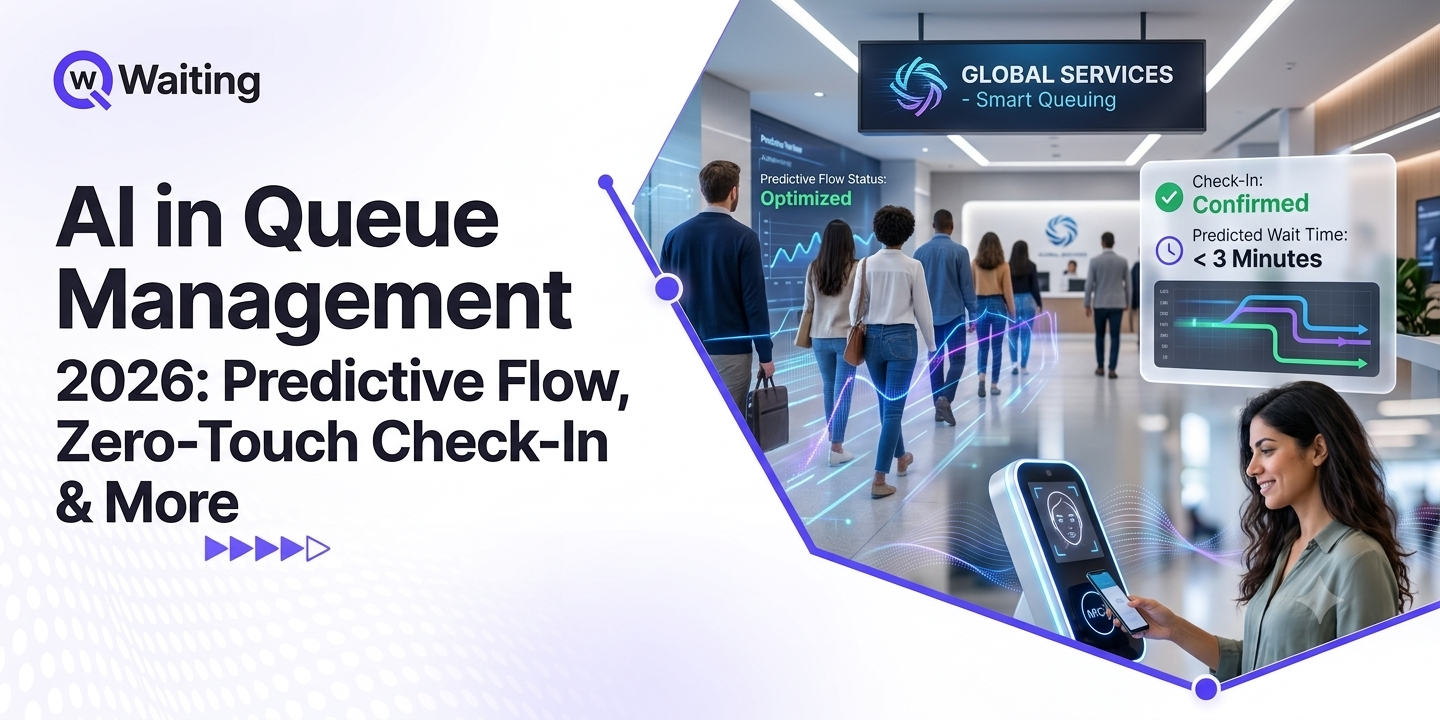
AI queue management in 2026 is shifting from simply managing waiting lines to predicting and optimizing customer flow. Key trends include predictive wait-time intelligence, AI-powered staff allocation, zero-touch check-in, smarter appointment and walk-in coordination, real-time notifications and analytics, and self-service experiences. These technologies help businesses reduce congestion, improve customer experiences, and make faster, data-driven operational decisions.
Where most queue management solutions shine is in answering the question: Who’s next? But very few have an answer to the question that operations managers are asking: What is going to happen at 12:30 pm on a random Tuesday afternoon, and are we prepared for it? It is this gap that the future of AI-based queue management solutions in 2026 will fill. While the focus of these solutions will change from queue management to customer flow anticipation through analysis of appointment, walk-in, and service time data, many other tangible trends are emerging in the process. This guide explains what each one means, where it helps, and what to look for when you evaluate a platform. It also covers how AI appointment booking software fits into the picture. Traditional queue management organizes people who have already arrived. AI adds a layer that looks at patterns and helps you plan for people who are about to arrive. A conventional system reacts. The line grows, a supervisor notices, and someone opens another counter. By then, customers have already waited. AI-assisted systems work with historical and live data to spot patterns, such as which days run heavy, which services overrun, and when walk-ins cluster. The question transforms from "How long is the queue?" to "What is likely to happen next, and what should we do about it?" Customers rarely judge a wait by its length alone. They judge whether it feels necessary, predictable, and well managed. AI supports that in a few ways: Wait-time information that reflects current conditions, not a fixed guess Routing that sends people to the right service point the first time Automated notifications, so customers are not guessing Staff allocation that follows demand instead of a fixed roster Less uncertainty, which is often what frustrates people most Digital queues are now common. The pressure has shifted to what comes next: accuracy, coordination, and foresight across every way a customer can arrive. Flights, groceries, and ride-hailing services are booked via mobile devices, and this habit transfers to waiting in clinics, branch offices, and government departments. Waiting with no information is entirely different from waiting with complete information. Lack of information is what makes a wait of ten minutes an unhappy experience. Operations staff typically outline the same list of issues: Congestion during peak hours occurring more quickly than it can be addressed Inconsistent workload, with one counter overloaded while another is empty Appointment overlaps that push booked customers into the same line as walk-ins Walk-in traffic that is hard to forecast Multiple service points that do not share a view of demand None of these is solved by a longer queue display. They need better information earlier. Reports tell you what happened last week. That is useful for planning, but it does not help at 10:45 on a busy Monday. This is one of the most apparent advancements of 2026. A digital queue shows you the present. A predictive one adds a view of the next few hours, which is when most staffing decisions actually get made. Predictive queue management uses past and current data to estimate demand and waiting times before they become a problem. Real-time monitoring tells you a queue has formed. Prediction tells you one is likely to form, so you can act first. Useful predictions depend on the data behind them. Common inputs include: Historical traffic patterns by day and season Appointment volumes already booked Walk-in behavior at different times Time of day and day of week Average and actual service duration, by service type Trends at the level of each location Service duration matters more than people expect. A simple count of people waiting says little if one service takes four minutes and another takes forty. A forecast is nothing without the ability to do something about it. Typical responses include: Moving or adding staff before congestion builds Adjusting how many appointment slots are offered Redirecting customers to a less busy service point Sending proactive notifications about expected delays Preparing rooms, counters, or stock for expected demand Those first minutes set the tone for the entire visit. Check-in is where many organizations still lose time and create crowds. Zero-touch check-in lets customers join or manage their place in line with little or no physical interaction. They use their own phone or a self-service point, not a reception desk or a shared device. The entry points are familiar, and what matters is how they connect: QR-based check-in on arrival Joining a queue from a mobile phone, sometimes before arriving Digital confirmation of appointments Updates over SMS or WhatsApp, so people can wait wherever they are comfortable Biometric and face-based check-in can also reduce friction in some settings, though it needs careful attention to privacy rules and local regulations. Less crowding at reception is the obvious gain. The quieter one is front-desk capacity. When fewer people need a staff member just to be registered, those staff can handle questions that need judgment. Entry is faster, physical touchpoints drop, and the journey feels more convenient from the first minute. Queues are one moment in a longer journey. AI becomes more useful when it looks across the whole of it. AI customer flow is the intelligent coordination of customers across the stages of a service, from booking or arrival through to the final desk. The aim is a visit that moves, not one that stops and starts. Most of these systems operate in three distinct ways. Appointments go into one, walk-ins go to another system, and remote queuing goes to yet another system. The consequence is that those with appointments will have to queue behind the walk-in visitors, or vice versa – that is, walk-ins will not be allowed to enter when there are open appointments. This is where the use of AI-based appointment scheduling comes in handy. Appointment scheduling AI will allow you to create some openings for walk-ins and schedule slots based on the forecasted demand, and then keep adjusting your capacity based on demand throughout the day. Routing is about matching a person to the right service at the right time. That means: Sending customers to the desk that handles their request Directing visitors based on live capacity and availability Easing bottlenecks between departments before they spread Seven developments stand out. Some are mature, and some are still arriving, so check how far each has progressed before you plan around it. Estimates are shifting from simple averages toward predictions that account for live conditions and service type. Customers notice accuracy quickly. A wait that is shown honestly earns more trust than an optimistic guess. Staffing levels can follow predicted demand, not last year's roster. This is often where the largest operational gain sits. Check-in moves to the customer's phone or a kiosk, which reduces dependence on reception and shrinks physical queues. Real-time walk-in demand can shape how many appointments are offered. Neither group is left to absorb the other's delays. Timely updates through SMS, WhatsApp, and other channels reduce uncertainty. The key word is timely. A message that arrives too early or too late is noise. Live dashboards surface bottlenecks and unusual patterns while there is still time to respond, such as a service taking far longer than usual. Kiosks, digital check-in, and routing together give customers more control. Staff are freed for cases that need a person. The principles are shared, but each sector feels waiting differently. These four show the range. Patient flow is the central concern. Digital check-in cuts crowded waiting areas, which matters where patients may be unwell. Coordinating appointments with walk-ins and routing patients between departments helps clinical staff keep to schedule. Branches deal with teller queues, service desks and booked advisory meetings at once. Appointments, routing and workload visibility help managers see which counters are under strain. Wait-time data supports better staffing decisions. Retail queues form at checkout, service counters and click-and-collect points. Peaks are sharp and short. Managing flow during those windows, and offering customers help without a long line, protects both sales and staff morale. Public offices handle high visitor volumes and a wide mix of services. Citizen appointments, walk-in access, and routing across departments support fairness and transparency. Reducing congestion also helps accessibility for people who cannot stand for long. Qwaiting approaches this as a customer journey problem, not only a line problem. The sections below separate what the platform covers today from where the broader industry is heading. Qwaiting is a global queue management and customer journey platform. Queue handling connects with appointments, virtual queues, kiosks, notifications, and customer flow, so organizations are not stitching together separate tools for each stage. The practical building blocks include: Virtual Queue Management, so customers can join remotely Appointment Scheduling, tied into the wider journey Self-service kiosks for check-in Digital displays for on-site updates SMS and WhatsApp notifications Analytics for operational visibility Predictive queue management is a direction for the whole industry, and it rests on good data about arrivals, service times, and capacity. A platform that already connects those sources is better placed to support that shift. Treat the current product capabilities and the future direction as separate questions, and ask any vendor, including us, to show which features are live today. Vendors use the word AI loosely. These five checks help you separate real capability from marketing. Ask whether the platform identifies patterns and demand changes, and how. Request a demonstration using realistic data, not a polished sample. Customers should be able to start in several ways: a physical kiosk, QR or mobile, the web, an app, or an appointment booking. All of them should land in one flow. Look for SMS, WhatsApp, digital displays, and automated updates. Check that messages reflect actual queue status and not a fixed template. A system that works for one site may struggle across fifty. Consider single-site use, multi-location groups, and enterprise or government deployments, each with its own reporting and permissions. Dashboards should help someone decide something. Useful measures include: Waiting time and service time Customer volume Staff performance Peak periods Trends by location Queue management via AI technology is shifting from line control to customer flow intelligence. Predictive queue management enables companies to plan rather than respond. Zero-touch check-in eliminates friction at the entrance, and AI customer flow unites what were previously separate pieces of the journey. Underlying everything is an ongoing change in expectations that includes fewer waits, reduced uncertainty, and increased control. The developments of 2026 share one idea. Waiting is easier to manage when it is easier to see coming. AI is much more than most people think. The value comes from journeys that are more predictable and operations that respond sooner. That means a customer who knows when they will be seen, and a manager who knows where to place staff before the rush. Organizations that prepare their queue infrastructure now, with connected entry points, clean service data, and flexible scheduling, will be ready as intelligent flow management matures. The useful question is simple: if demand doubled at noon tomorrow, would your current setup warn you in time? Still relying on physical lines to manage customer demand? Explore how Qwaiting can help your organization move from reactive queue handling to a more connected, flexible customer journey.What Is AI Queue Management in 2026?
From Managing Lines to Predicting Customer Flow
How AI Changes the Customer Waiting Experience
Why AI Is Becoming a Major Queue Management Trend in 2026
Rising Customer Expectations for Faster Service
Businesses Require More Control Over Customer Traffic
The Shift From Historical Reporting to Predictive Intelligence
Predictive Queue Management: The Next Step Beyond Digital Queues
What Is Predictive Queue Management?
How AI Predicts Waiting Times and Demand
How Businesses Can Act on Predictions
Zero-Touch Check-In Is Revolutionizing the Guest Check-In Process
What Is Zero-Touch Check-In?
QR Codes, Mobile Check-In and Digital Entry Points
Why Zero-Touch Check-In Matters
AI Customer Flow: From One Queue to the Entire Journey
What Does AI Customer Flow Mean?
AI Can Connect Appointments, Walk-Ins and Virtual Queues
Smarter Routing Across Service Points
7 AI Queue Management Trends to Watch in 2026
1. Predictive Wait-Time Intelligence
2. AI-Powered Staff Allocation
3. Zero-Touch Customer Check-In
4. Intelligent Appointment and Walk-In Coordination
5. AI-Powered Customer Notifications
6. Real-Time Queue Analytics
7. Smarter Self-Service Experiences
How AI Queue Management Can Transform Different Industries
Healthcare
Banking
Retail
Government
Qwaiting and the Future of AI-Powered Customer Flow
One Platform for the Modern Customer Journey
From Virtual Queues to Smarter, Data-Driven Operations
Building a More Predictive Customer Experience With Qwaiting
What Should Businesses Look for in an AI Queue Management Platform?
Predictive Analytics
Omnichannel Queue Entry
Real-Time Customer Communication
Scalability Across Locations
Actionable Analytics
Is AI the Future of Queue Management, or the New Standard?
Final Thoughts