


Deliver fast, reliable service with a cloud system that updates in real-time and scales with your business.

Control your data and infrastructure with a secure, offline-ready solution tailored for complex environments.

Empower customers to check in, book, or update their appointments without staff assistance.

Deliver fast, secure access for repeat visitors using AI-powered facial recognition.
 Banking
Streamline customer flow and reduce wait times in banks and financial institutions.
 Healthcare
Refine patient check-ins and improve healthcare service.
 Public
Sector
Public
Sector
Manage citizen services smoothly in government offices and public institutions.
 Retail
Improve shopping experiences by minimizing checkout lines and wait times.
 DMV
DMV
Organize customer service queues in automotive showrooms and service centers.
 Airport
Speed up passenger processing with efficient queue management at terminals.
All Industries → AI Appointment Booking System
Automate appointment scheduling with AI-powered booking, smart reminders, and seamless customer check-ins.
 Appointment
Booking
Appointment
Booking
Offer flexible scheduling that helps customers plan their visit and avoid peak-time congestion.
 Biometric
System
Biometric
System
Speed up identity verification and check-ins using facial or fingerprint recognition.
 Automation
Automate workflows and reduce manual tasks with smart queue solutions.
 Virtual
Queuing
Virtual
Queuing
Let customers wait from anywhere home, car, or cafe with mobile-based virtual queues.
 Visitor
Management
Visitor
Management
Track and manage visitor entry, exit, and ID verification from a single dashboard.
 Video
Queue
Video
Queue
Allow people to join video calls instantly with one link—no apps, Accessible on any browser.
 Tele-Consultation
Offer seamless virtual consultations with real-time communication tool.
All Solutions →
Explainer
Videos
Watch quick product demos and tutorials to understand how Qwaiting works for your business.
 Blog
Blog
Read expert insights, tips, and industry trends to enhance customer experience.
 Ebooks
Download in-depth guides and resources to explore queue management best practices.
 Self Guided
Demo
Self Guided
Demo
Explore Qwaiting in a quick interactive demo, no signup needed.
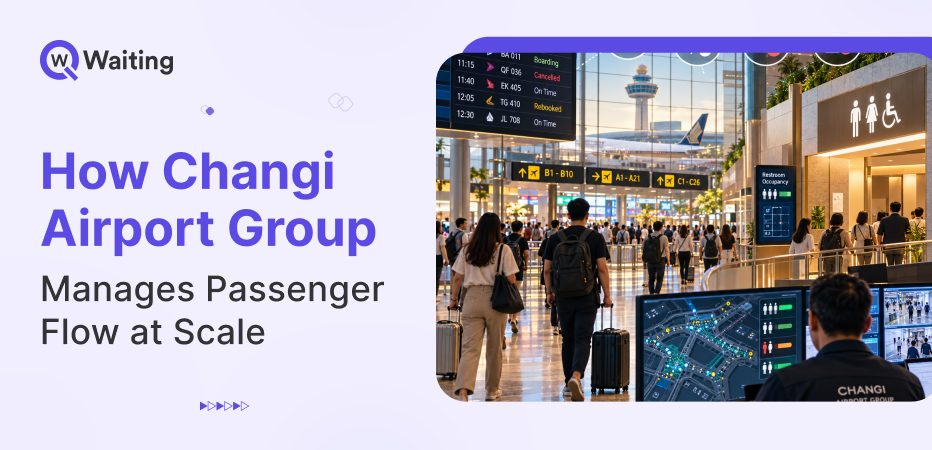
Changi Airport Group uses digital queue management to streamline passenger flow, reduce waiting times, improve staff efficiency, and create a smoother passenger experience.
Changi Airport moves more than 68 million passengers a year through four terminals that never close. Flights land, get delayed, cancelled, and rebooked around the clock, and every one of those changes ripples through the building in ways passengers barely notice but operations teams have to manage in real time. Most conversations about passenger flow focus on speed; how quickly people can move from check-in to the gate. Passenger flow is really about controlling demand before it turns into congestion, giving people enough information to make their own decisions, and giving airport teams a clear enough picture of what's happening to act before a small issue becomes a visible one. Changi Airport Group, consistently ranked among the best-run airports in the world, ran into exactly this problem with a facility most travelers take for granted: restrooms. What they did about it, and the results that followed, offer a genuinely useful blueprint for any high-traffic service environment trying to manage flow rather than just react to it. A quick note before the Changi specifics: passenger flow breaks in fairly predictable ways, and the usual fixes rarely hold up once you look closely. One delayed flight sends hundreds of people toward the same gate or restroom within minutes. A cancellation does the reverse; it empties a busy area and slams a rebooking desk instead. Airport staff is built around average demand, but average demand rarely shows up on any given afternoon. It's the high-traffic spots near gates and transit corridors that absorb the swing, because those are what passengers reach for the second a schedule changes. A queue caused by a disruption rarely stays contained to the queue itself. It tends to drag other things down with it: Crowding that makes a space feel chaotic even when the actual wait isn't that long Staff pulled off their planned work to manage foot traffic and repeat the same directions Zero visibility into which areas are under strain until they're already swamped Facilities nearby sitting half-empty because nobody knows they exist Frustration that colors how a traveler remembers the airport, regardless of how the flight itself went Cutting wait times sounds like a facilities problem. It's really a visibility problem first. Teams need live occupancy numbers, current queue status, a read on where people are moving, and facility availability they can check at a glance. Skip that, and every response to congestion is reactive; someone spots a line, calls for backup, and by the time help shows up, the surge has often already passed. Airport passenger flow management works only if operations can see a problem coming before passengers do. Scale makes Changi a useful case study. Problems that stay minor at a smaller airport turn into real operational drag here. Four terminals, running nonstop, serve as a major connection point between Asia, Europe, the Middle East, and beyond. There's no overnight lull to reset or catch up. A congestion problem at 2 a.m. is exactly as real as one at 2 p.m. The airport just doesn't get a quiet window either way. The friction, by the airport's own account, centered on restrooms. Delayed and rescheduled flights sent passengers toward counters in waves nobody could predict. No pre-booking option existed, so demand had nowhere to go except into a physical line. Foot traffic was hard to track, meaning some facilities stayed jammed while others sat nearly empty a short walk away. Staff kept getting pulled into the same basic navigation questions, over and over, simply because there was no other way for passengers to find out where to go. This didn't show up as one big visible failure. It showed up as a pattern. Congestion in certain zones, unused capacity a few minutes away, staff spending time on wayfinding instead of whatever they were actually supposed to be doing. Once demand starts shifting faster than a team can respond to it manually, that gap stops being a minor inconvenience and starts costing real operational time. Four connected pieces of technology, working together, gave the airport control over something that had previously run on guesswork. Qwaiting placed self-service kiosks near terminal and lounge areas. With one tap, a passenger could reserve restroom access instead of lining up to ask a staff member. Each kiosk displayed live wait times and availability, so people could decide for themselves, wait nearby, duck into a shop, or walk to a different facility altogether. Passengers got a digital ticket through virtual queuing instead of standing in line, with a notification when their turn got close. Small change, bigger effect than it sounds: it separates waiting from standing still. Ten minutes spent browsing a shop doesn't feel like ten minutes spent in a physical line, even though the clock says otherwise. A live dashboard gave staff one place to see occupancy, queue activity, and facility status across the whole airport. Cleaning and maintenance decisions got faster. More than that, the operations team finally had a way to catch pressure building before it turned into a queue anyone could see. Digital signage across the terminals showed which restrooms were open and pointed passengers toward the shorter lines. This is the piece that moves the whole approach from managing individual queues to managing flow across the entire facility, actively pushing demand toward capacity that already existed, instead of letting congestion stack up in the same predictable spots. Measured within 30 days of rollout, here's what moved. Restroom queues dropped 45% once virtual ticketing took over from physical lines. This wasn't really about faster service; it was about passengers no longer needing to physically occupy a line while they waited. Lines simply stopped forming the way they used to, even during delay-driven surges. Staff productivity rose 28%, mostly because repetitive navigation questions dropped off sharply. Cleaning crews used live occupancy data to plan their rounds instead of guessing. Time that used to disappear into "where's the nearest restroom" went back into actual work. Passengers checked availability and booked access themselves, no staff member required. That took pressure off front-line teams for routine requests and gave travelers something to hold onto during delays: a bit of control, which tends to be scarce exactly when people need it most. Digital guidance sent travelers toward facilities that weren't already packed, instead of letting everyone pile into the same handful of spots. Probably the most consequential shift in the whole case: Changi stopped reacting to congestion after it appeared and started actively managing where demand went in the first place. Step back from the restrooms specifically, and a few broader lessons emerge. Virtual queuing didn't make anything process faster. It changed when passengers arrived, spreading demand out instead of letting it collide all at once. Managing timing can matter just as much as managing capacity. Kiosks didn't replace staff. They took a category of routine interaction off their plate — one that was eating time without adding much value. Self-service earns its keep when it absorbs the repetitive parts of a job and leaves the rest for people. Dashboards gave staff visibility. Signage gave passengers the same visibility, just in a form they could act on immediately. Same idea in two directions: information reaching someone before they have to go ask for it. This is the part an operations leader should sit with longest. "Better passenger experience" is hard to act on. Wait time reduction, productivity gains, and adoption numbers can actually weigh against the cost and disruption of rolling something out. Worth highlighting what Qwaiting specifically contributed here, since the shift runs deeper than any one feature. It started with removing the assumption that a queue has to mean a line of people standing in one place. Kiosks gave passengers direct control over booking and check-in. The knock-on effect: staff spent noticeably less time fielding the routine requests that used to chip away at their day. Dashboard visibility, occupancy monitoring, live queue data, usable reporting; all of it gave the operations team a real foundation for decisions they'd been making on instinct before. Digital signage closed the loop, actively distributing passengers instead of just reacting once congestion had already formed. Managing individual queues became orchestrating movement across the whole facility. The full Changi Airport Group case study has the complete breakdown if you want more detail. Airport-specific in the details, but the approach travels well to anyone managing high-volume, unpredictable foot traffic. Find where passengers actually hit friction, rather than treating each queue as its own problem to solve in isolation. Changi's restroom bottleneck wasn't really about restrooms — it was a symptom of passengers having no way to check availability or reserve ahead. Virtual queues that let people wait wherever they want Self-service booking for routine requests Digital notifications when their turn is near Real-time availability they can act on right away Demand, utilization, queue activity, service performance — all of it needs to live in one place. Teams that only find out about congestion once it's visible on the floor are already behind. Signage and notifications that actively point people toward open capacity usually beat throwing more staff at an already-overwhelmed area. Balancing demand across what you already have tends to be cheaper and faster than building more of it. Qwaiting's blog covers this more broadly in how airports are cutting passenger wait times with digital queue management, across check-in, security, and boarding. Waiting time, queue volume, staff productivity, facility utilization, passenger throughput — track all of it before and after. Without a baseline, you can't really tell if a new process helped or just relocated the problem somewhere harder to see. Before reaching for new technology, it's worth being honest about where your current process actually breaks. Where do queues form, and when? Which facilities turn into bottlenecks during disruptions? How much staff time goes into repeating directions? Which areas sit underused while others stay jammed? Virtual queuing Self-service kiosks Digital signage Real-time dashboards Passenger notifications Changi's numbers didn't come from one tool doing all the work. They came from connecting self-service, virtual queuing, staff visibility, and passenger guidance into a single system built around how people actually move through a building. If your airport is still handling that by hand, Qwaiting's airport queue management solutions are worth a look. Airports rarely fail at passenger flow because of one broken process. They fail because demand outpaces visibility, and visibility outpaces how fast staff can respond by hand. Changi Airport Group's numbers show what happens when that gap closes: queues that used to form out of necessity stopped forming, staff time went back to work that needed an actual person, and facilities that used to sit unevenly loaded finally balanced out. The real question isn't whether passenger flow can be improved — Changi already answered that. It's whether your current approach to queuing, wayfinding, and staffing was built for the demand you have now, or the demand you had when someone first designed the process. Still relying on physical lines to manage passenger demand? See how Qwaiting can help your airport move from reactive queue handling to a connected, data-driven passenger flow strategy.Why Passenger Flow Management Is a Critical Airport Operations Challenge
Passenger Demand Can Change Within Minutes
Physical Queues Create More Than Just Waiting Time
Airports Need Visibility Before They Can Control Flow
Changi Airport Group: The Passenger Flow Challenge
Managing Passenger Movement Across a 24/7 Airport
Where Passenger Flow Was Breaking Down
The Operational Cost of Unpredictable Demand
The Changi Airport Queue Management Approach
Self-Service Kiosks for Restroom Booking
Virtual Queuing Instead of Physical Waiting
Real-Time Dashboards for Airport Staff
Digital Signage to Redistribute Passenger Flow
What Changed After Implementing the Solution?
45% Reduction in Waiting Queues
28% Improvement in Staff Productivity
Self-Service Became Part of the Passenger Journey
Better Distribution of Passenger Demand
What Changi Airport's Results Reveal About Smarter Passenger Flow
Reducing Queues Starts With Managing Demand
Self-Service Can Take Pressure Off Airport Teams
Real-Time Information Helps Airports Respond Faster
Passenger Flow Improvement Can Be Measured
How Qwaiting Helped Changi Airport Group Transform Passenger Flow
From Physical Queues to Virtual Passenger Flow
From Staff-Dependent Processes to Self-Service
From Limited Visibility to Real-Time Operational Control
From Congestion Management to Flow Optimization
What Airport Operators Can Learn From the Changi Airport Queuing Case Study
Start With the Passenger Journey, Not the Queue
Give Passengers Alternatives to Physical Waiting
Give Operations Teams Real-Time Visibility
Use Digital Guidance to Balance Demand
Measure the Operational Outcome
Could Your Airport Reduce Waiting Without Expanding Physical Capacity?
Assess Your Current Passenger Flow
Explore a Smarter Passenger Flow Strategy
See How Qwaiting Can Support Airport Passenger Flow
Final Thoughts