
Deliver fast, reliable service with a cloud system that updates in real-time and scales with your business.

Control your data and infrastructure with a secure, offline-ready solution tailored for complex environments.

Empower customers to check in, book, or update their appointments without staff assistance.

Deliver fast, secure access for repeat visitors using AI-powered facial recognition.
 Banking
Streamline customer flow and reduce wait times in banks and financial institutions.
 Healthcare
Refine patient check-ins and improve healthcare service.
 Public
Sector
Manage citizen services smoothly in government offices and public institutions.
 Retail
Improve shopping experiences by minimizing checkout lines and wait times.
 DMV
Organize customer service queues in automotive showrooms and service centers.
 Airport
Speed up passenger processing with efficient queue management at terminals.
All Industries → AI Chatbot
Intelligent conversational AI that answers questions, books appointments, and assists 24/7.
 AI Appointment Booking System
Automate appointment scheduling with AI-powered booking, smart reminders, and seamless customer check-ins.
 Appointment
Booking
Offer flexible scheduling that helps customers plan their visit and avoid peak-time congestion.
 Biometric
System
Speed up identity verification and check-ins using facial or fingerprint recognition.
 Automation
Automate workflows and reduce manual tasks with smart queue solutions.
 Virtual
Queuing
Let customers wait from anywhere home, car, or cafe with mobile-based virtual queues.
 Visitor
Management
Track and manage visitor entry, exit, and ID verification from a single dashboard.
 Video
Queue
Allow people to join video calls instantly with one link—no apps, Accessible on any browser.
 Tele-Consultation
Offer seamless virtual consultations with real-time communication tool.
All Solutions → Become a Partner
Start your Qwaiting partner journey.
 Reseller Partner
Program
Unlock new revenue by reselling Qwaiting solutions.
 Become a Sales Partner
Turn customer relationships into new revenue opportunities.
 Become a Development Partner
Build smarter customer journeys by connecting your technology.
 Become a Hardware Partner
Bring your devices, kiosks, and displays into connected customer flow.
Explainer
Videos
Watch quick product demos and tutorials to understand how Qwaiting works for your business.
 Blog
Read expert insights, tips, and industry trends to enhance customer experience.
 Ebooks
Download in-depth guides and resources to explore queue management best practices.
 Self Guided
Demo
Explore Qwaiting in a quick interactive demo, no signup needed.
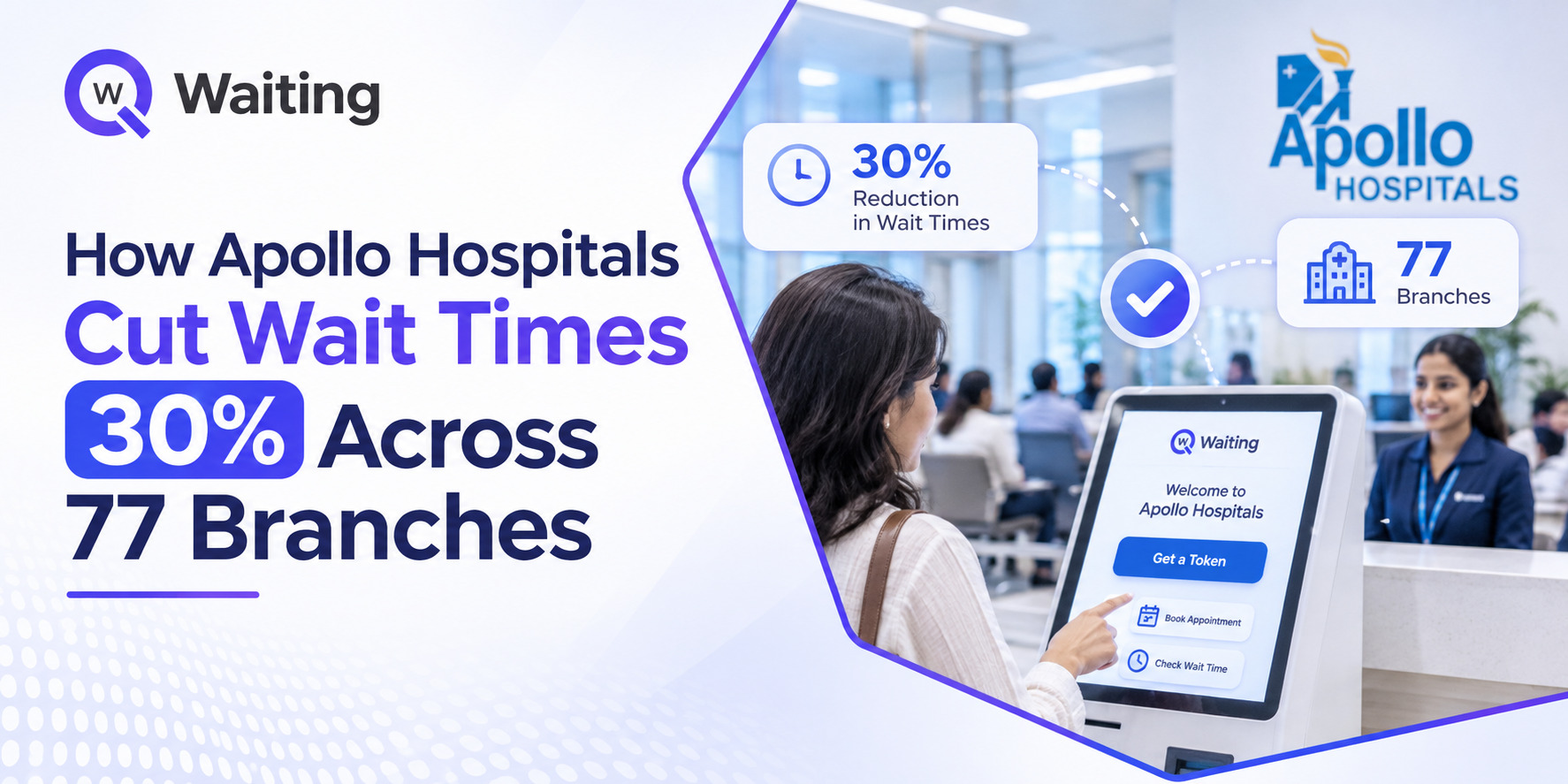
Learn how Apollo Hospitals improved patient flow and reduced wait times by 30% across 77 branches through smarter queue management, helping create a more efficient and patient-friendly healthcare experience.
In 2024, patients at Apollo Hospitals were waiting at least an hour before they saw a doctor. Behind the front desk, things weren't much calmer. Staff were managing long physical lines by hand while also typing each patient's details into two systems that didn't talk to each other. Apollo runs 77 branches, so this was no small, local headache. Adding receptionists wouldn't have solved it. You'd just have more people re-entering the same data. So what did help? According to Qwaiting's published case study, Apollo cut patient wait times by 30% (up to half an hour per patient) and reduced manual staff work by 40%. This hospital queue management case study looks at how Apollo got there with Qwaiting, and which parts of its approach other hospital groups can realistically borrow. Every branch had a busy waiting room. The harder problem was that the same manual process, with the same weak spots, was running in 77 places at once. Apollo opened its first hospital in Chennai in 1983. Four decades on, it's one of the best-known names in Indian healthcare. The Qwaiting rollout alone covers 77 branches, and each one sees around 200 to 300 patients a day. Run those figures and you get roughly 15,000 to 23,000 patient arrivals a day across the network. At that volume, tiny delays stop being tiny. Add two minutes at registration, repeat it across 20,000 visits, and you've created more than 650 hours of waiting in a single day. Size changes the management problem, too. In one hospital, an operations manager can walk downstairs and see a line forming at a busy counter. Nobody can do that for 77 branches. At that scale, the floor has to report back on its own, live, and in a way that lets one branch be fairly compared with another. Qwaiting's write-up describes four problems. They fed each other in a fairly predictable loop. The first was the line itself. Patients stood for an hour or more before a consultation, and staff had to manage those queues in person. That ate into everything else the front desk was meant to be doing. Then there was coordination, or the lack of it. With no central dashboard, administrators had no easy way to follow a patient from registration to consultation. They also couldn't tell which department was swamped and which had room to spare. Tracking was manual as well. Someone had to count how many patients were waiting, how many had been seen and how many appointments had been cancelled. It was slow, and mistakes crept in. The fourth problem deserves the most attention. Apollo runs its own hospital information system (HIS), called MedMantra, and the queue process wasn't connected to it. So staff were entering the same patient details into two separate pieces of software. Double entry sounds like a clerical nuisance. But it happens at the registration desk, which is exactly where the line is longest. Every repeated field adds a few seconds for the patient at the counter and for everyone behind them. And once two systems hold two versions of the same record, nobody fully trusts the numbers, which makes the other three problems even harder to fix. Qwaiting worked alongside Apollo's operations and IT teams to set up a modular hospital queue management system built around existing workflows, with each piece aimed at one of those four problems. Apollo kept MedMantra exactly where it was. Staff used it every day, and it held the hospital's patient records. Replacing it would have solved one problem by creating another. Instead, Qwaiting's team worked with MedMantra and connected the two systems, so patient data could move between them without anyone re-typing it. Errors dropped. Departments started working from the same information. And front-desk staff got back a big slice of their day, since Qwaiting puts the cut in manual work from this integration at 40%. If you sit on the IT side of a hospital group, this is the step to study. A queue system bolted on next to the HIS, with no data flowing between the two, usually adds a screen to the receptionist's day rather than taking one away. Next came self-service kiosks at the service counters. A patient walks up, picks the doctor they want on the touchscreen, confirms the booking and pays the consultation fee. No staff member has to get involved. The kiosk only asks for basics such as name and phone number, so it stays quick even for someone visiting for the first time. Once the booking is done, a token number lands on the patient's phone, showing their place in the queue and roughly how long they'll wait. Alerts follow as the line moves. That phone alert matters more than it looks. When the queue lives on the patient's phone, nobody has to hover near the counter waiting to hear their name. Staff, in turn, no longer spend their shift calling names out one at a time. Qwaiting also added smart routing, which sends patients toward less crowded departments. It spreads the load more evenly across teams and played its part in bringing waits down. The last piece was a centralized admin dashboard. From one screen, staff and administrators can watch live updates, follow a patient's journey and keep an eye on several branches at once. It looks ahead, too. The dashboard's reports use AI to predict upcoming appointments from past booking patterns. That means administrators can adjust staffing before a busy morning arrives, instead of scrambling once the waiting room is already full. Qwaiting says the effects showed up within weeks of going live. Put side by side, the before-and-after picture looks like this. Look at how the rows connect. The shorter waits and the lighter workload come from the same change in how patient information moves, and that's what makes this a useful healthcare wait time reduction case study. It isn't a story about one clever gadget. If you used to wait an hour, getting half of it back is hard to miss. Patients feel this result more directly than any other, and Qwaiting links it to higher patient satisfaction and a better brand image for Apollo. The knock-on effect is just as useful for operations. Shorter waits mean fewer people in the waiting area at any given moment, and the case study reports less overcrowding at reception as a result. A calmer reception area is simply easier to run. Then there's how a wait feels. Most of us put up with a delay more patiently when we know where we stand and roughly how long it'll take. Apollo's patients now have both on their phones. 40% less manual work for staff Qwaiting attributes this figure to the MedMantra integration and the end of double data entry. Kiosks and automated reminders helped remove other more mundane tasks from the front desk, such as booking and announcing names. In Qwaiting's telling, front-desk teams now spend their time on patients instead of crowd control. A freed-up staff in a hospital, however, represents hidden capacity. It helps cope with growing numbers of patients without necessarily increasing numbers of employees proportionally. The other thing this freed-up staff can be used for is having people talk at the desk where the job still requires human. Real-time visibility across all 77 locations Hospital directors can now see patient volume and performance branch by branch, as the day unfolds. The hand-kept tallies of who was waiting, who'd been seen and who'd cancelled have given way to live analytics reports. It is the toughest to quantify. It may also turn out to be the most enduring benefit. Wait time is likely to increase again when either the demand increases or there are fewer employees at one of the branches, and live data provides the management with the opportunity to spot that right away. Kiosks and phone alerts are the parts patients see. For hospital leaders, the bigger value lies in how the pieces connect and how consistently they run from one branch to the next. Plenty of hospitals buy these capabilities piecemeal: a kiosk from one supplier, a messaging tool from another, reporting from somewhere else. Each one does its own job well enough. The trouble sits in the gaps between them, and staff end up filling those gaps by hand. Apollo's setup avoids that. When a patient books at the kiosk, that one action sets their place in the queue. Their place in the queue then triggers the alerts on their phone. Meanwhile, the same activity shows up on the central dashboard, and the integration passes patient data through to MedMantra. No one re-keys anything or has to reconcile two sets of numbers later. That's the difference between a ticketing tool and a patient-flow platform. Information travels on its own, so staff don't have to carry it. Large hospital networks rarely drift apart on purpose. It happens slowly, as each branch invents its own workarounds, until the patient experience depends on which door someone happens to walk through. A shared platform puts every branch on the same footing. Check-in follows the same steps, patients get the same alerts, and the reports define things the same way everywhere. Suddenly, comparisons between branches mean something. If waits climb at one location, leaders can see it against the other 76 and ask what's different there. That's how Apollo Hospitals queue management went from a local fix to a network standard. Qwaiting describes the setup as modular and scalable, which is what a group this size needs. Hospital groups weighing something similar can look at Qwaiting's enterprise solution for multi-branch operations. If you're comparing vendors, Apollo's experience suggests four questions to raise early: Will it integrate with our current HIS, or will staff end up entering data twice? Can every branch run the same workflow while still reflecting its own departments and doctors? Will head office see live data for each location, in a form that can be compared? Do tokens and wait-time alerts reach patients automatically? None of Apollo's fixes was exotic. Connecting MedMantra got rid of double entry. Kiosks and phone alerts took routine work off the front desk and told patients how long they'd wait. A central dashboard let leaders see all 77 branches at once. What ties them together is a point that reaches well beyond Apollo. Long hospital waits are often a coordination problem first and a capacity problem second. Patients sit and wait because information is slow to travel from the desk to the departments and on to management. Speed that up, and the queue usually shrinks with it. For practical steps beyond queue technology, such as layout, scheduling and staff training, our guide on improving hospital patient flow management is a good next read. And here's a question worth putting to your own team this week: between a patient walking in and sitting down with a doctor, how many times does someone type, check or call out the same piece of information? See how Qwaiting can help your hospital improve patient flow. Request a demo and see how check-in, queues, patient alerts and branch-level reporting could work together across your locations.Apollo Hospitals Case Study: 77 Locations, One Patient-Flow Challenge
The Scale of Apollo Hospitals' Operations
The Original Patient Queue and Staff Workflow Challenges
How Qwaiting Helped Apollo Hospitals Improve Patient Flow
Integrating Qwaiting With the Existing MedMantra System
Streamlining Patient Check-In and Queue Management
Improving Real-Time Visibility Across Hospital Locations
The Results: How Apollo Hospitals Improved Queue Efficiency
Patient Wait-Time Reduction Across 77 Locations
Reducing Manual Workload for Hospital Staff
Improving Visibility Into Daily Patient Flow
What Made Qwaiting Valuable for Apollo Hospitals
Connecting Patient Check-In, Queue Updates, and Operational Monitoring
Supporting Consistent Queue Management Across Locations
Improve Patient Flow at Your Hospital With Qwaiting