

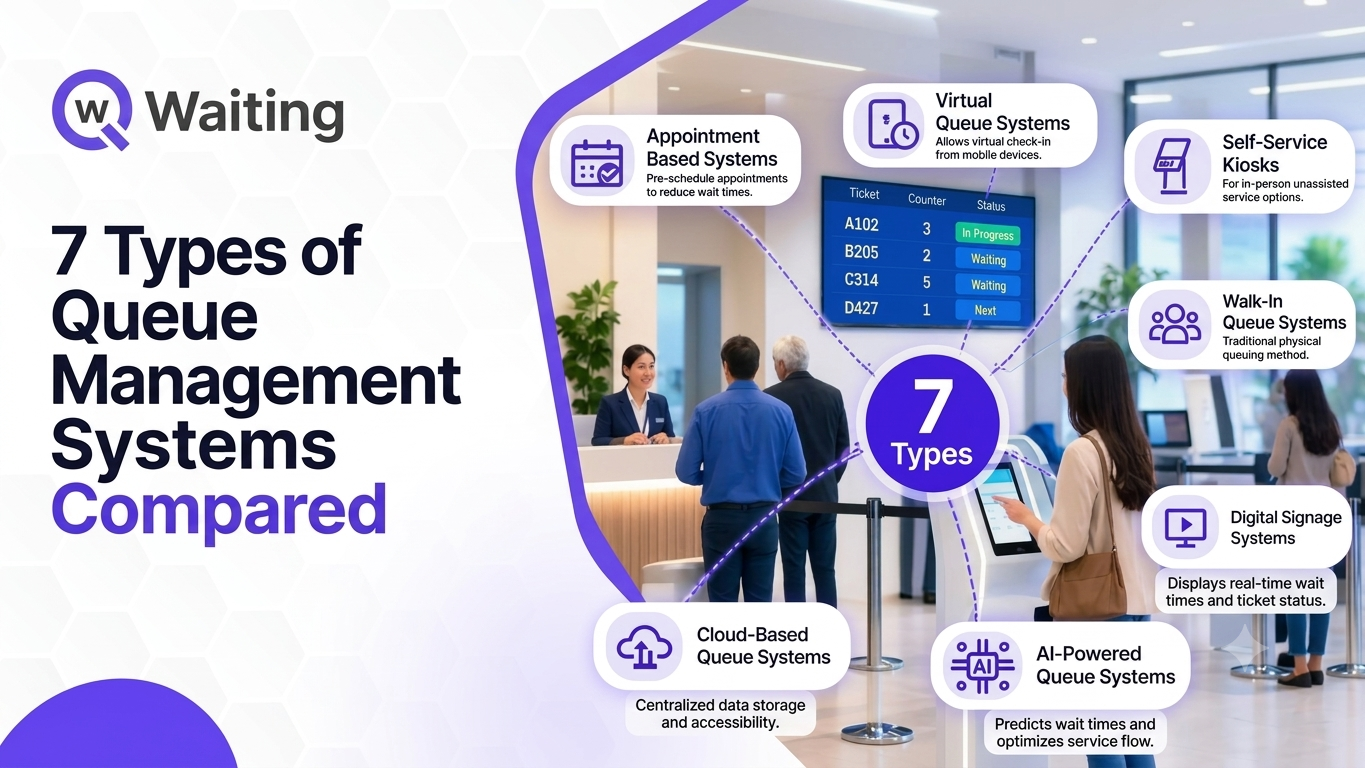
7 Types of Queue Management Systems Compared
Oct 07, 2026

Deliver fast, reliable service with a cloud system that updates in real-time and scales with your business.

Control your data and infrastructure with a secure, offline-ready solution tailored for complex environments.

Empower customers to check in, book, or update their appointments without staff assistance.

Deliver fast, secure access for repeat visitors using AI-powered facial recognition.
 Banking
Streamline customer flow and reduce wait times in banks and financial institutions.
 Healthcare
Refine patient check-ins and improve healthcare service.
 Public
Sector
Public
Sector
Manage citizen services smoothly in government offices and public institutions.
 Retail
Improve shopping experiences by minimizing checkout lines and wait times.
 DMV
DMV
Organize customer service queues in automotive showrooms and service centers.
 Airport
Speed up passenger processing with efficient queue management at terminals.
All Industries → AI Chatbot
Intelligent conversational AI that answers questions, books appointments, and assists 24/7.
AI Appointment Booking System
Automate appointment scheduling with AI-powered booking, smart reminders, and seamless customer check-ins.
 Appointment
Booking
Appointment
Booking
Offer flexible scheduling that helps customers plan their visit and avoid peak-time congestion.
 Biometric
System
Biometric
System
Speed up identity verification and check-ins using facial or fingerprint recognition.
 Automation
Automate workflows and reduce manual tasks with smart queue solutions.
 Virtual
Queuing
Virtual
Queuing
Let customers wait from anywhere home, car, or cafe with mobile-based virtual queues.
 Visitor
Management
Visitor
Management
Track and manage visitor entry, exit, and ID verification from a single dashboard.
 Video
Queue
Video
Queue
Allow people to join video calls instantly with one link—no apps, Accessible on any browser.
 Tele-Consultation
Offer seamless virtual consultations with real-time communication tool.
All Solutions → Become a Partner
Start your Qwaiting partner journey.
 Reseller Partner
Program
Reseller Partner
Program
Unlock new revenue by reselling Qwaiting solutions.
 Become a Sales Partner
Turn customer relationships into new revenue opportunities.
 Become a Development Partner
Build smarter customer journeys by connecting your technology.
 Become a Hardware Partner
Bring your devices, kiosks, and displays into connected customer flow.
Explainer
Videos
Watch quick product demos and tutorials to understand how Qwaiting works for your business.
 Blog
Blog
Read expert insights, tips, and industry trends to enhance customer experience.
 Ebooks
Download in-depth guides and resources to explore queue management best practices.
 Self Guided
Demo
Self Guided
Demo
Explore Qwaiting in a quick interactive demo, no signup needed.

Here are some abandonment impacts on the business and how it limits the revenue growth:
| Cost Type | Examples | Business Impact |
| Direct Revenue Loss | Abandoned purchases, walkouts, reduced basket size | Immediate top-line reduction |
| Operational Inefficiency | Staff idle time, overtime spikes, uneven capacity use | Margin compression |
| Retention Erosion | Churn acceleration, reduced visit frequency | Long-term revenue decline |
| Competitive Displacement | Market share loss to faster alternatives | Strategic positioning damage |
Also Read: Why Waiting Feels So Much Longer Than It Really Is

Also Read: Why Fixing Wait Times Requires System Change, Not Quick Solutions
Long wait times reduce revenue by increasing walkaways, lowering basket size, and discouraging repeat visits. Even when customers stay, frustration often limits additional purchases. Over time, poor waiting experiences accelerate churn and damage brand perception.
Bottlenecks typically result from legacy systems, manual processes, and poor demand coordination. When appointments, walk-ins, and staffing aren’t aligned, congestion becomes unavoidable. Most delays are structural—not demand-driven.
Virtual queues let customers join remotely and arrive only when it’s their turn. Clear updates reduce uncertainty and frustration. This significantly lowers walkaways and incomplete transactions.
Real-time queue analytics, smart scheduling, and centralized visibility tools help prevent congestion. Integrated systems align staffing with live demand. The focus shifts from reacting to lines to designing smooth flow.
Yes. Queue optimization increases throughput without adding physical space. It improves capacity use and standardizes service across locations, making expansion more efficient and less risky.