


Deliver fast, reliable service with a cloud system that updates in real-time and scales with your business.

Control your data and infrastructure with a secure, offline-ready solution tailored for complex environments.

Empower customers to check in, book, or update their appointments without staff assistance.

Deliver fast, secure access for repeat visitors using AI-powered facial recognition.
 Banking
Streamline customer flow and reduce wait times in banks and financial institutions.
 Healthcare
Refine patient check-ins and improve healthcare service.
 Public
Sector
Public
Sector
Manage citizen services smoothly in government offices and public institutions.
 Retail
Improve shopping experiences by minimizing checkout lines and wait times.
 DMV
DMV
Organize customer service queues in automotive showrooms and service centers.
 Airport
Speed up passenger processing with efficient queue management at terminals.
All Industries → AI Appointment Booking System
Automate appointment scheduling with AI-powered booking, smart reminders, and seamless customer check-ins.
 Appointment
Booking
Appointment
Booking
Offer flexible scheduling that helps customers plan their visit and avoid peak-time congestion.
 Biometric
System
Biometric
System
Speed up identity verification and check-ins using facial or fingerprint recognition.
 Automation
Automate workflows and reduce manual tasks with smart queue solutions.
 Virtual
Queuing
Virtual
Queuing
Let customers wait from anywhere home, car, or cafe with mobile-based virtual queues.
 Visitor
Management
Visitor
Management
Track and manage visitor entry, exit, and ID verification from a single dashboard.
 Video
Queue
Video
Queue
Allow people to join video calls instantly with one link—no apps, Accessible on any browser.
 Tele-Consultation
Offer seamless virtual consultations with real-time communication tool.
All Solutions →
Explainer
Videos
Watch quick product demos and tutorials to understand how Qwaiting works for your business.
 Blog
Blog
Read expert insights, tips, and industry trends to enhance customer experience.
 Ebooks
Download in-depth guides and resources to explore queue management best practices.
 Self Guided
Demo
Self Guided
Demo
Explore Qwaiting in a quick interactive demo, no signup needed.
Explore how patient flow management optimizes every stage of the healthcare journey, from check-in and waiting to treatment and discharge, reducing delays and improving patient experience.
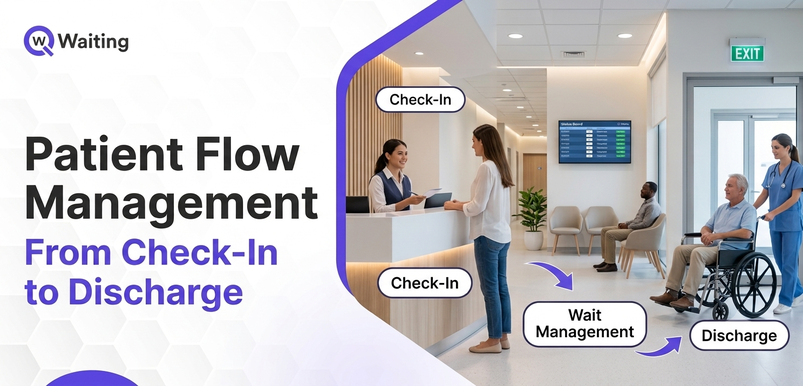
The patient flow process includes all stages that a person has to pass when visiting a hospital, starting from their arrival and ending with their discharge. Each stage depends on the previous one. Most hospitals aren't stuck on one broken step. They're stuck on poor teamwork between many steps. Overcrowding, unclear updates, and staff pulled in too many directions are all symptoms of one thing: a patient journey that isn't connected end to end. Patient flow management software exists to close that gap. It links check-in, queuing, tests, and discharge into one visible process. The idea behind this piece is simple: when patients move through a building more smoothly, both sides win. Operations get better. So does the patient experience. Patient flow management is how patients, staff, information, and resources move together across every department a patient touches. It isn't limited to the waiting room. That's different from traditional queue management. A queue system manages one thing: who goes next at a single counter. Patient flow management looks at the whole hospital journey instead. It connects queues, bookings, departments, and messages into one picture, not a set of separate lines. Cuts down on waiting that serves no medical purpose Improves how beds, rooms, and staff time get used Prevents bottlenecks between departments Gives patients a more predictable visit Gives hospital leaders real visibility into how care moves Poor flow rarely comes from one failure. It builds up from several small ones at once: Manual registration and repeated data entry Long queues at busy departments like radiology Conflicts between booked appointments and walk-ins Delays getting patients to tests or specialists Departments that don't share a patient's status Discharge steps split across several teams There is no real-time way to track patient locations All visits in a hospital follow the same general journey. However, the majority of the areas where improvements can be made fall under one concept: view it as one process, not six different departments. Check-in creates the foundation for everything that comes after. It covers confirming identity, checking an existing appointment, or registering a walk-in from scratch. Hospitals still doing this by hand tend to see it back up first. That's especially true during morning peaks. Digital and self-service kiosk check-in changes that picture. Patients confirm their own details instead of waiting for a staff member to type them in. Reception lines shrink. Front-desk staff can focus on patients who truly need help. Triage determines who is a priority, who will go straight to see the specialist, and who can wait without harm. This step prevents the patient from being misdirected to another department later on. That wastes everyone's time. Real-time visibility into a patient's status, rather than a paper chart passed hand to hand, makes this handoff faster. It's also less prone to error. This is usually where patients feel the wait the most. It's the stage where they have the least information. Virtual queuing lets them wait outside a crowded room, or somewhere else entirely, and get notified as their turn nears. A short text saying "you're two patients away" does more for comfort than a long wait spent watching a number board. Many patients see more than one department. Consultation, then the lab, then imaging. Sometimes back to a specialist again. Each handoff is a chance for delay. Coordinating these separate queues so a patient isn't stuck waiting at every stop is one of the more overlooked wins in patient flow. The gap between services often matters as much as the wait at any one stop. For admitted patients, flow now depends on three things: open beds, how fast rooms get cleaned, and transfers between wards. A hospital can run a smooth outpatient process and still lose most of that gain right here. That happens when bed status isn't visible in real time. Slow transfers between wards are common, and mostly avoidable, and they cause real holdups at this stage. Discharge is an area where hospitals devote much of their efforts. Discharge is rarely confined to just one department. This process needs to have signatures of doctors, medicines supplied by the pharmacy, clearance from the billing department, and so on. The process involves many departments. So, even though a patient is prepared to leave the hospital by 10 a.m., he or she might stay till 2 p.m. because of the paperwork needed. Bottlenecks commonly occur in certain areas. Being aware of these locations will help in prioritization. Peak-hour crowds, paper forms, and re-entering details a patient already gave all slow this stage down. That happens right when volume is highest. Patient volume is high, and visit times vary a lot. That makes any wait estimate hard to trust. It's part of why OPD waiting rooms feel chaotic, even when staff work hard and fast. Test capacity is limited. Several queues overlap. Staff often can't see where a patient stands. All of this piles up fast. Demand here is hard to predict. Staff must weigh urgent cases against a growing line of less critical ones. That needs a system built for priority, not just first come, first served. Doctors, billing, and pharmacy all need to line up. On top of that, slow discharge holds up bed turnover. That makes discharge one of the hardest stages to fix on its own. Software alone doesn't fix a broken process. It does make it possible to see and coordinate the whole process at once. That's where most manual systems fall short. One system links check-in, bookings, queues, tests, and discharge. Staff get a view they wouldn't have otherwise. A nurse in radiology can see a patient is already on the way, instead of finding out when they show up. Virtual queue management lets patients hold a spot in line without sitting in a crowded room. Digital queue numbers, remote waiting, and wait-time estimates all cut down the crowding that makes rooms feel worse than the wait itself. SMS and WhatsApp updates, appointment reminders, and queue alerts replace the guesswork patients deal with otherwise. Knowing when to expect a call to the next window matters more to most patients than shaving a few minutes off the wait. When it's clear which departments are busy and which have room to spare, hospitals can shift staff and cut idle time. That beats relying on guesswork department by department. Wait-time data, volume trends, and peak-hour patterns turn a vague complaint into something you can fix. That could mean adjusting shifts or adding staff at a known choke point. For hospitals still on the fence about modernizing, it helps to see the differences laid out side by side. Patients stand in physical lines. Staff call out names by hand. No one can reliably track how long someone has actually been waiting. All of this adds friction, and it compounds during busy periods. Digital check-in, virtual waiting, automatic alerts, and live data change that. They turn a messy process into one staff can plan around. A recent look at queue management for clinics shows how this plays out in smaller, busy clinics. Cutting out needless waiting between stages, not just at the front desk, is what shortens the whole visit. A patient who checks in fast but then waits twenty minutes between two departments hasn't gained much. Less uncertainty. Fewer crowded rooms. A clearer sense of what happens next. These shape how a patient remembers a visit, often more than the clinical outcome does. Better staff placement. Smoother handoffs between departments. Better use of rooms and gear. All of this comes from one connected view of flow, not several disconnected ones. Moving more patients through the same building, without adding staff or space, is one of the clearest gains once flow improves. Hard numbers replace guesswork. The leaders can notice the recurring bottleneck from one week to another, rather than being notified of it in hindsight. List down every touchpoint in the patient journey, from their arrival to their discharge, noting the places where they spend their time waiting, repeating themselves, and moving aimlessly. Begin with the high-traffic departments and processes which have a major impact on many patients. Do not try to address all the issues at once. Booking, queuing, and registration must be based on a common database. This is an integrated flow which is an alternative to separate solutions. SMS and WhatsApp notifications, appointment reminder, and queue notification make the patients feel comfortable, as they do not have to stay by the reception desk. Track the wait time, service time, and number of patients served after every change. This information can be used for further improvements of the process. Qwaiting treats patient flow as one connected journey, not a set of separate queues. Digital and self-service check-in cuts down front-desk lines. It points patients to the right service. Staff don't get extra steps to manage. Patients can join a queue remotely where that makes sense. Staff still manage physical and virtual queues from one view, so no one loses their place by waiting off-site. For visits that touch more than one service, staff can see where a patient stands right now. This will reduce the time being spent moving from one department to another, not just within each individual department. Reminders, appointments reminders, and turn notifications will inform your patients. No need for repeated visits to the reception desk. Wait times, bottlenecks, and service trends can help inform decision-makers.That beats a pile of isolated complaints. Qwaiting's healthcare solutions are built around that ongoing view, not a one-time fix. None of this is about shorter queues for their own sake. It's about giving leaders a patient journey they can predict, and a clear view of how care moves through the building. Online, mobile, on-site, and kiosk check-in, so patients aren't stuck with just one way to start a visit. Live updates for staff and patients alike, not a fixed estimate set when the queue began. OPD, tests, pharmacy, billing, and specialist care, all in one flow. Not run as separate silos. SMS, WhatsApp, and auto alerts built right into the system, not tacked on later. Wait times, service times, patient volumes, and how each department is doing. All in one place, no separate tool needed. Room to grow, and it links up with the systems a hospital already runs. Hospitals should measure the whole journey, not just how long people wait at reception. A few metrics matter most: Patient waiting time, tracked across every stage, not only the front desk Patient throughput, or how many patients move through the building in a given period Average service time, by department, to spot visits or tests that run long Department utilization, to see which areas run over or under capacity Patient satisfaction, since a shorter wait doesn't always feel better if updates are poor Appointment no-show and delay rates, which quietly hurt flow before a patient even reaches the waiting room Patient flow is an end-to-end challenge, not a set of queues that happen to sit next to each other in the same building. A patient doesn't experience a hospital department by department. They live through one visit, start to finish. Every disconnected handoff along the way shows up as frustration, no matter which team caused the delay. Patient flow management software works because it treats check-in, queuing, updates, diagnostics, and discharge as parts of one process. It doesn't solve them one at a time. The goal was never just to make queues shorter. It's to make the whole hospital journey more predictable, more efficient, and easier for patients and staff alike. Still running check-in, queuing, and discharge as separate systems that don't talk to each other? It might be worth a look at what a connected queue management solution could do for a hospital your size.All of these can be available in a hospital - excellent physicians, modern facilities, and full staffing. Despite this, patients may experience delays of an hour even after their appointment times. The problem does not lie in the clinical aspect. Rather, it lies in the patient process flow.
What Is Patient Flow Management?
Why Patient Flow Matters in Modern Healthcare
What Causes Poor Patient Flow?
The Hospital Patient Process: From Arrival to Discharge
Step 1: Patient Arrival & Check-in
Step 2: Triage and Assessment
Step 3: Consultation and Waiting
Step 4: Diagnostics, Tests, and Procedures
Step 5: Admission and Inpatient Movement
Step 6: Discharge and Follow-Up
Where Can Patient Flow Bottlenecks Commonly Be Found?
Registration and Reception Area Bottlenecks
Outpatient Department Waiting Areas
Diagnostic Departments
Emergency Departments
Discharge Bottlenecks
How Patient Flow Management Software Improves the Hospital Patient Journey
Centralize Patient Flow Across Departments
Replace Physical Waiting With Smarter Queuing
Keep Patients Updated at Every Stage
Improve Staff and Resource Utilization
Use Data to Identify and Fix Bottlenecks
Healthcare Queue System vs. Traditional Hospital Queues
How Traditional Queues Create Operational Problems
What a Modern Healthcare Queue System Changes
Key Benefits of Better Patient Flow Management
Shorter Patient Waiting Times
Better Patient Experience
Higher Operational Efficiency
Improved Patient Throughput
Greater Visibility for Hospital Leaders
How to Implement Patient Flow Management in a Hospital
Map the Existing Patient Journey
Target the Largest Bottlenecks First
Link Appointments, Queues, and Registration Process
Use Digital Communication With Patients
Gauge Results Continuously
How Qwaiting Helps Hospitals Manage Patient Flow From Check-In to Discharge
Give Patients a Smoother Digital Check-In Experience
Connect Virtual Queues With In-Person Services
Coordinate Patient Movement Across Departments
Inform Your Patients About Their Appointments via SMS and WhatsApp Reminders
Use Patient Flow Information for Operational Decisions
What Should Hospitals Look for in Patient Flow Management Software?
Omnichannel Patient Access
Real-Time Queue and Patient Status
Multi-Department Support
Patient Communication
Analytics and Reporting
Scalability and Integration
Measuring the Success of Patient Flow Management
Final Thoughts: Better Patient Flow Starts With a Better Patient Journey