


Deliver fast, reliable service with a cloud system that updates in real-time and scales with your business.

Control your data and infrastructure with a secure, offline-ready solution tailored for complex environments.

Empower customers to check in, book, or update their appointments without staff assistance.

Deliver fast, secure access for repeat visitors using AI-powered facial recognition.
 Banking
Streamline customer flow and reduce wait times in banks and financial institutions.
 Healthcare
Refine patient check-ins and improve healthcare service.
 Public
Sector
Public
Sector
Manage citizen services smoothly in government offices and public institutions.
 Retail
Improve shopping experiences by minimizing checkout lines and wait times.
 DMV
DMV
Organize customer service queues in automotive showrooms and service centers.
 Airport
Speed up passenger processing with efficient queue management at terminals.
All Industries → AI Appointment Booking System
Automate appointment scheduling with AI-powered booking, smart reminders, and seamless customer check-ins.
 Appointment
Booking
Appointment
Booking
Offer flexible scheduling that helps customers plan their visit and avoid peak-time congestion.
 Biometric
System
Biometric
System
Speed up identity verification and check-ins using facial or fingerprint recognition.
 Automation
Automate workflows and reduce manual tasks with smart queue solutions.
 Virtual
Queuing
Virtual
Queuing
Let customers wait from anywhere home, car, or cafe with mobile-based virtual queues.
 Visitor
Management
Visitor
Management
Track and manage visitor entry, exit, and ID verification from a single dashboard.
 Video
Queue
Video
Queue
Allow people to join video calls instantly with one link—no apps, Accessible on any browser.
 Tele-Consultation
Offer seamless virtual consultations with real-time communication tool.
All Solutions →
Watch quick product demos and tutorials to understand how Qwaiting works for your business.

Read expert insights, tips, and industry trends to enhance customer experience.

Download in-depth guides and resources to explore queue management best practices.

Explore Qwaiting in a quick interactive demo, no signup needed.
Retail queue abandonment can quietly reduce revenue, repeat visits, and customer loyalty. The article explains its costs, key wait-time data, calculation methods, and how Qwaiting helps retailers manage queues.
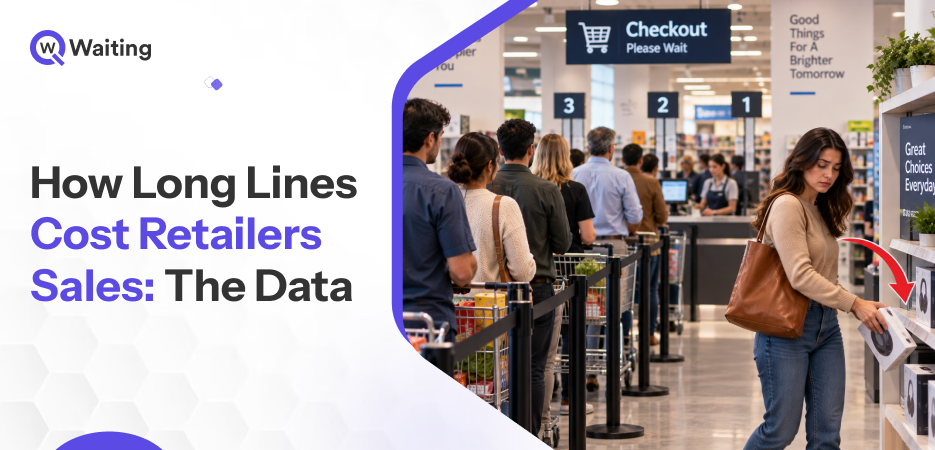
A shopper picks up exactly what they came for. They walk toward the checkout. Then they stop. The line isn't moving. After a minute or two, they set the item back on a shelf and leave. No complaint. No word to a manager. Just a sale that quietly stopped happening.
That's retail queue abandonment cost. The store does not lose money because of lack of sales of a particular item; rather, it does so because of the effort put into buying the item. It’s quite easy to categorize it as being related to customer services. The data says otherwise. Wait time is one of the clearest, most measurable drags on sales, repeat visits, and revenue per store.
This article looks at what the research shows about checkout line abandonment and retail customer wait time data. It also covers how to calculate what queues are costing you, and what actually works to fix it.
Before the cost, it helps to define the moment itself: the point where a shopper decides waiting isn't worth it.
Queue abandonment happens when a customer who planned to buy something leaves before paying. That's not the same as someone who changes their mind about a product. The intent to buy was already there. What broke down was the process of paying.
That matters. Abandonment isn't a merchandising problem. It shows up at the last step of the visit, right before the sale closes. And a shopper who walks away rarely tells anyone why.
Retailers often blame plain impatience. The research points to something more specific. It's less about the minutes, and more about how those minutes feel.
Long perceived wait times, even when the real wait is short.
Slow queues where nothing seems to be moving.
Too few open counters for the crowd in the store.
No estimate of how long the wait will run.
Checkout steps that feel slow or complicated.
A shorter line at another counter, or another store nearby.
None of these need the wait to be long. A five-minute wait with no information can feel worse than an eight-minute wait with a clear estimate posted nearby.
Abandonment isn't a rounding error. Tied to real transaction values and daily traffic, the numbers are hard to ignore.
One abandoned queue looks small. One shopper, one basket, one missed sale. Multiply this effect for each tier and each trading day, and you will see that even a low abandon rate will quickly multiply.
Research in retailing on “walk-aways” says customers who abandon their places in the queue without completing a purchase – puts the average abandonment rate at roughly 1.6 percent of all queue joiners.That looks small on paper. Across a chain with real daily volume, it isn't. This is why a retail queue abandonment cost is worth calculating store by store, not guessed from a national average.
The sale that didn't happen is the easiest cost to see. It isn't the only one:
Lower lifetime value, since a bad last impression colors the whole visit.
Fewer repeat visits, especially where competitors sit nearby.
Word of mouth that spreads faster than any single lost sale.
Staff time spent calming frustration instead of serving customers.
Missed upsells once a customer just wants to leave.
Retailers who only track abandoned transactions are measuring the smallest part of the problem.
Wait time tolerance has been studied for decades. The pattern holds: customers judge a queue by feel first, and by the clock second.
Estimates vary by study and store type, but they land in a useful range. A 2013 survey of over 1,300 UK shoppers by Omnico found shoppers will wait just under six minutes on average before giving up. More than half said they never went back to a store after a long wait.
Older research from M/A/R/C Research, based on nearly 13,000 shoppers across eight store types, found satisfaction holds up well to about four minutes. Past that, it drops fast. 43 percent said long lines affect where they shop in the future.
That gap matters more than either number. Customers don't time a queue with a stopwatch. They judge it by how uncertain it feels.
David Maister's research on the psychology of waiting explains the gap. Time occupied is felt as shorter than time unoccupied. A waiting period with a known end seems shorter than one without an end. Uncertainty, rather than the length of time, makes waiting uncomfortable.
This shows up in real behavior, too. A 2020 survey of 2,000 U.S. consumers by Quidini found over half were "more likely" or "much more likely" to avoid a store, or walk out empty-handed, because of a line. The same survey put the lost revenue across U.S. retailers at roughly 100 billion dollars a year.
It's tempting to file checkout abandonment under customer service. The financial mechanics say otherwise.
Online cart abandonment gets attention because it's easy to track. A session ends, a cart sits untouched, an email follows. Checkout line abandonment is the same thing in the physical world, except it's almost invisible. A shopper already picked the item and decided to buy it, then the last few minutes felt like more trouble than the purchase was worth. That's a finished decision, reversed at the last step, not a browser who never planned to buy.
A convenience-store study by Researchscape for Zynstra, an NCR company, found 15 percent of shoppers leave after just one minute of waiting. Nearly half of those leave inside 30 seconds. In a format built around speed, that patience runs out almost right away.
Scale that across dozens or hundreds of stores, and it stops being a one-store story. It's a pattern worth tracking, not one bad Saturday.
None of this matters without a number retailers can act on. The formula below is simple by design.
A workable starting point:
Estimated Queue Abandonment Cost = Abandoned Customers × Average Transaction Value
A fuller picture adds a few variables:
Average transaction value: abandonment at a high-ticket counter costs more per incident.
Abandonment rate: measured store by store, not assumed from a national figure.
Daily customer volume: the same rate scales differently at 200 sales a day versus 2,000.
Peak-hour traffic: this is where abandonment concentrates.
Repeat purchase value: the cost of a customer who never comes back.
The formula stays simple on purpose. You don't need a data team to start. You need a way to count abandoned queues, and to multiply.
Consider a middle-sized shop that has 800 daily transactions with an average basket size of 40 dollars. With a moderate 2 percent abandonment ratio, which is in accordance with walk-away research studies, this is how the situation appears:
For one store, that's close to 200,000 dollars a year, gone without a single complaint filed. Across 50 similar stores, that same 2 percent rate adds up to roughly 10 million dollars a year, before counting the customers who never come back at all. Any manager can run this math with numbers already sitting in a POS system. The hard part isn't the math. It's remembering to run it.
Most checkout setups are built for average demand. Retail traffic rarely behaves like an average.
Weekends, holidays, and flash sales do not just add one or two extra customers. They put a day’s worth of customer traffic into hours, often minutes. A system that works well on Tuesday may fail on Saturday when the only thing that is different is the amount of traffic. Demand just stopped being spread out evenly. This is where abandonment piles up, and where that four-minute limit from the M/A/R/C research gets crossed most often.
Adding registers and staff helps, up to a point. It's costly to staff for peak demand all year, when most of that extra help sits idle outside a few busy hours a week, and a store can't plan its whole schedule around its busiest 90 minutes. The better fix isn't more capacity. It's managing how customers move through the capacity a store already has.
None of the causes above are unsolvable. Most come down to giving customers more information, and more choice in how they wait.
Virtual queues that hold a spot in line without standing in it.
Digital queue tickets issued at the door or by QR code.
Appointment-based visits for returns, consultations, or busy departments.
Notifications that alert a customer when it's their turn.
The common thread is control. A customer who can step away and keep browsing feels the wait very differently than one stuck standing still.
Estimated wait times shown at the door.
Digital displays showing live queue position.
Live updates as the line moves.
SMS and WhatsApp alerts, so no one has to watch a screen.
A wait with a number attached, even a rough one, feels more bearable than an open-ended one.
Finding peak periods by day and hour.
Tracking real wait times against internal targets.
Watching service speed by counter and shift.
Spotting bottlenecks before they turn into complaints.
Setting staffing by measured demand, not habit.
Retailers who treat this data as routine, not a once-a-quarter report, tend to catch problems while they're still small.
This is the part of the problem Qwaiting was built for: not erasing queues, but giving retailers real control over how customers experience them.
Qwaiting's virtual queue management system allows customers to enter a queue using their mobile phones before reaching the store or a QR code. After entering the store, they don't have to wait in one place. This does not mean that waiting has been removed but that it is no longer the sole focus. This is the essence of Qwaiting's retail queue system.
Real-time queue position and wait-time updates.
Digital signage showing live status at service points.
SMS and WhatsApp alerts through Qwaiting's messaging services.
Clear visibility into how long a wait is actually expected to run.
That combination targets the uncertainty that research keeps tying back to abandonment.
Every queue also creates data retailers can use, through Qwaiting's business intelligence tools:
Queue and service analytics by location, counter, and shift.
Customer flow insights that show where bottlenecks form.
Peak-time analysis that supports staffing ahead of a rush.
Ongoing performance tracking, not a one-time audit.
Qwaiting isn't just about swapping a physical line for a digital one. It's about giving retailers more control over customer flow, waiting experiences, and the decisions that follow. For more on the financial side of this, The Economics of Waiting breaks down how service bottlenecks hit revenue and retention more broadly.
Where retail queuing is heading isn't really about queues. It's about how much control customers expect over their own time.
Customers who can track a delivery in real time don't leave those expectations at the store door. A line with no information and no flexibility now reads as outdated, not just annoying. That's pushing queues toward one piece of a more flexible visit, where a shopper might book ahead, join a virtual queue, or just walk in.
A far better customer experience at the most frustrating point of the visit.
Fewer abandoned purchases at checkout and service counters.
Smarter staffing, built on real demand instead of guesswork.
Stronger loyalty tied to a smoother last impression.
Better use of customer-flow data across the business.
The retailers who get ahead of this won't be the ones with the shortest lines. They'll be the ones whose customers stop noticing the wait at all.
A long line rarely announces itself as a revenue problem. It looks like a Saturday rush, a short-staffed shift, or a self-checkout kiosk acting up again. But the research is consistent: customers have a real, measurable limit for how long they'll wait, and past that limit, some percentage simply leave, taking the sale, and often the relationship, with them.
Retail queue abandonment cost isn't a theory. It's a number every retailer can calculate today, using data that's usually already sitting in a POS system. What most retailers lack isn't the ability to measure it. It's the habit of treating it as worth measuring at all.
If you knew exactly how much revenue your checkout queues were costing you, would you still treat waiting as just a customer service issue?
Retailers who've moved past guessing tend to start the same way: putting a number on what their lines actually cost, then testing whether a virtual queue system changes it. If checkout abandonment has never been measured at your stores, Qwaiting is a reasonable place to see what that would look like in practice.