


Deliver fast, reliable service with a cloud system that updates in real-time and scales with your business.

Control your data and infrastructure with a secure, offline-ready solution tailored for complex environments.

Empower customers to check in, book, or update their appointments without staff assistance.

Deliver fast, secure access for repeat visitors using AI-powered facial recognition.
 Banking
Streamline customer flow and reduce wait times in banks and financial institutions.
 Healthcare
Refine patient check-ins and improve healthcare service.
 Public
Sector
Public
Sector
Manage citizen services smoothly in government offices and public institutions.
 Retail
Improve shopping experiences by minimizing checkout lines and wait times.
 DMV
DMV
Organize customer service queues in automotive showrooms and service centers.
 Airport
Speed up passenger processing with efficient queue management at terminals.
All Industries → AI Appointment Booking System
Automate appointment scheduling with AI-powered booking, smart reminders, and seamless customer check-ins.
 Appointment
Booking
Appointment
Booking
Offer flexible scheduling that helps customers plan their visit and avoid peak-time congestion.
 Biometric
System
Biometric
System
Speed up identity verification and check-ins using facial or fingerprint recognition.
 Automation
Automate workflows and reduce manual tasks with smart queue solutions.
 Virtual
Queuing
Virtual
Queuing
Let customers wait from anywhere home, car, or cafe with mobile-based virtual queues.
 Visitor
Management
Visitor
Management
Track and manage visitor entry, exit, and ID verification from a single dashboard.
 Video
Queue
Video
Queue
Allow people to join video calls instantly with one link—no apps, Accessible on any browser.
 Tele-Consultation
Offer seamless virtual consultations with real-time communication tool.
All Solutions →
Explainer
Videos
Watch quick product demos and tutorials to understand how Qwaiting works for your business.
 Blog
Blog
Read expert insights, tips, and industry trends to enhance customer experience.
 Ebooks
Download in-depth guides and resources to explore queue management best practices.
 Self Guided
Demo
Self Guided
Demo
Explore Qwaiting in a quick interactive demo, no signup needed.
Government queue management helps reduce citizen wait times, improve service efficiency, and create more predictable experiences through virtual queues, appointments, self-service, notifications, and real-time analytics.
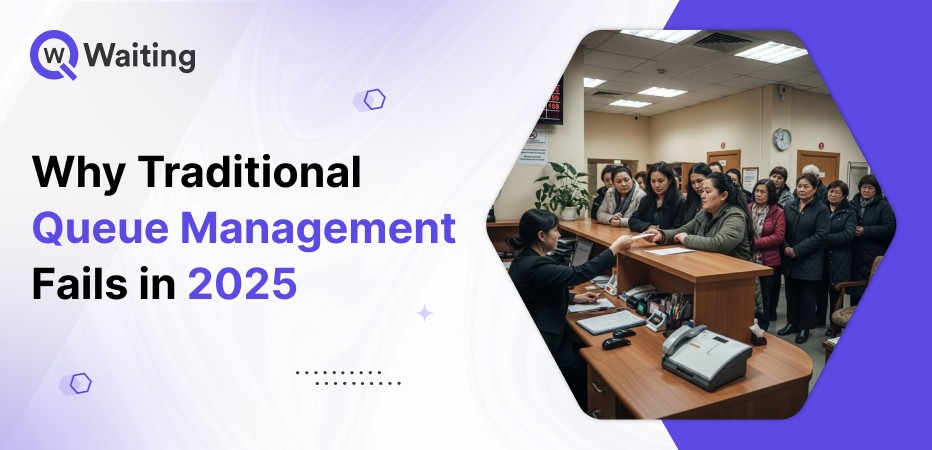
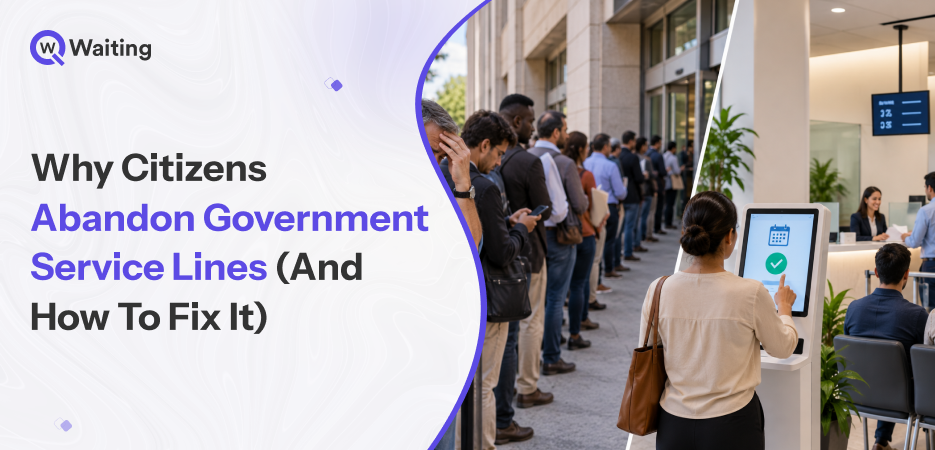
A long line outside a government office costs more than time. It costs trust. It costs staff hours, and it quietly creates repeat work nobody budgeted for.
Walk into a passport office, a tax counter, or a municipal service center, any Monday morning will do, and you can see same long line of frustrated citizens. People check their watches. Some step outside to make a call and never come back.
It's tempting to blame this on volume, and sometimes that's fair. More often, it isn't. Agencies that actually dig into their own data usually find the real problem isn't staffing. It's how the queue gets managed: how citizens join it, and how much they know once they're standing in it. Predictability turns out to matter more than headcount.
This is the problem government queue management is meant to solve. Done well, it turns an open-ended wait into something closer to a scheduled visit. Done poorly, it quietly pushes citizens out of the line and back to square one.
Abandonment rarely comes down to one cause. It usually builds from uncertainty and poor visibility.
Ask a citizen how long they've waited, and they can tell you. Ask how much longer, and most can only guess.
That gap is where frustration builds. For anyone with work, childcare, or a bus to catch, that matters a lot. It often decides whether they stay or go.
A physical line tells you almost nothing. You see who's ahead of you. That's it. You don't know how many counters are open, or whether the person ahead of you brought in a case that'll take forty minutes to sort out.
People fill that silence with worry, not patience. (Somewhere behind the counter, someone's having a perfectly ordinary day. You'd never guess it from where you're standing.) Queue transparency isn't a small detail in public services. It's often the difference between a wait people tolerate and one they walk away from.
Manual, paper-based workflows slow things down twice. Once at intake. Again every time a form has to be checked or re-entered by hand.
Citizens often discover mid-visit that they need a second counter, or a different department. Each extra step adds its own small queue. What feels like one wait to the citizen is often three or four waits joined together. There's no single view of the whole visit.
All citizens do not have the luxury of having a spare afternoon available to wait in the waiting lounge. Since the services are available only for walk-ins, everybody who has the same work to be done comes simultaneously, causing unnecessary congestion.
Appointment system along with walk-in system allows citizens to make a choice. They can either schedule an appointment or come without making any appointment depending upon which suits them better.
Citizens often can't tell if a counter is closed for lunch, running late, or simply unstaffed. There's no way to know without asking someone in person. Without SMS alerts or digital updates, there's only one way to stay informed. Stay in the building and watch the door. That one requirement, staying put with no updates, is enough to push some citizens out for good. Abandonment doesn't end the transaction. It just delays and complicates it, for both the citizen and the agency. A missed visit means a missed renewal, application, registration, or payment. But since deadlines don’t change due to the fact that the line was long, the citizen will need to make another appointment, which will most likely cost them more money than they would have paid for the previous one because there are fines, penalties, etc. Most citizens don't separate "the wait" from "the service." A badly managed wait becomes part of how they judge the whole visit. It shapes how they see the agency behind it. A helpful employee at a well-run counter can still leave a poor impression. That happens if reaching the counter took two hours in an unmanaged line. An abandoned visit tends to become two visits later. The one that didn't happen, and the repeat attempt. Staff field the same questions twice. They spend more time managing frustrated crowds and less time actually serving people. That adds work without adding real output. Abandonment is also a signal, one many agencies never study closely. A rising abandonment rate at one counter or one time of day usually points to something real. It's rarely just random. Agencies that track this closely tend to catch real problems before they turn into public complaints. This look at online queuing in government offices shows what that looks like. Reducing wait times rarely means adding more counters. It usually means giving citizens better options for how, when, and where they wait. A virtual queue lets citizens join a line without standing in it. They check their position from a phone. They run an errand nearby. They get called back as their turn gets close. The line still exists. It just doesn't need anyone's presence in the room until it matters. Appointments spread demand evenly across the day instead of letting it pile up at opening time. Walk-ins still need a path too, since not every citizen can plan ahead. The strongest setups run both side by side. Appointments smooth out the predictable demand. Walk-in slots stay open for people who show up unannounced. An estimated wait time, updated as the queue moves, removes most of the guesswork behind frustration. SMS or WhatsApp alerts stretch that visibility outside the building. Citizens aren't stuck in a chair just to avoid missing their turn. Staff also spend less time answering "how much longer?" and more time actually serving people. Self-service kiosks handle the routine parts of a visit: checking in, confirming a few basic details, maybe printing a ticket if the office still uses them. None of that needs a human. Move it off the counter and staff get their time back for the cases that actually need judgment, like a complex application or a dispute nobody can resolve by clicking a button. Queue data shows peak hours, average service time per counter, and exactly where bottlenecks form. That's a better basis for staffing decisions than habits carried over from last year. An agency that knows Tuesday mornings run busier than Wednesday afternoons can staff for that. It beats using the same schedule every day. Before choosing a solution, it helps to be clear on what the term actually covers. Government queue management is the shift from one physical line to several channels working together. Walk-ins, virtual queues, appointments, and self-service all feed into one view instead of running as separate systems. A citizen might book online, check in at a kiosk, and get updates by SMS. The system treats all of it as one journey, not three unrelated steps. Public sector queue software gives agencies one view across counters and departments. Those used to run as separate silos. Staff can see where citizens are backing up in real time. Citizens get real information instead of guesses. Leadership gets measurable data on service performance, instead of stories from the front desk. Qwaiting works as one platform for the whole citizen journey. Not a ticket screen bolted to a lobby wall. Appointments, walk-ins, virtual queues, and self-service all link into a single flow. No channel has to run on its own. That's the idea behind Qwaiting's government queue management solutions. Citizens join remotely and get called when it's actually their turn. That cuts physical crowding and hands people back control of their own time. Scheduled visits, walk-in traffic, and kiosk check-ins all run through the same system. Staff aren't juggling separate lists for each channel. SMS and messaging updates tell citizens where they stand and when to head back. That removes most of the uncertainty that pushes people to leave early. Dashboards track wait times, service times, and volume by counter and by hour. Agency leaders can see exactly where a process breaks down, instead of guessing from complaints. The right fit depends less on a feature list. It depends more on how well a system matches the way citizens actually move through a building. A modern system should manage the full citizen journey, not just print tickets. Look for these working together: Virtual queues Appointments Self-service Notifications Analytics A single ticket printer rebranded as software won't cover all of that. Some citizens are happy to book online. Others need to walk in and ask a person directly. A good system supports both, without making either group feel like an afterthought. A tool that works for one branch should still work across ten. Departments need to share data, not run as isolated systems that can't talk to each other. Before rolling anything out, agree on what "better" will look like. A handful of metrics tell most of the story: Citizens shouldn't burn a morning off work for a routine renewal. That expectation is changing. More public offices are judged the same way as any other service: on how well they respect people's time. The goal was never simply shorter lines. It's about a more predictable, easier way to deliver public services. Citizens should be able to plan around a wait, not lose a day to one. Citizens don't abandon government service lines because they're impatient. They leave because the wait feels random, hidden, and cut off from the rest of their day. Add up long waits, no visibility, manual steps, limited scheduling, and poor updates. Walking away starts to look like the easy choice. Fixing that isn't about hiring more staff or adding another counter. It takes virtual queuing and appointments that run next to walk-ins, not instead of them. Real-time updates fill in the rest, and self-service handles what doesn't need a human at all. What's left is data, and data is the only thing that tells an agency where its own process is actually breaking. Citizens already manage their banking and their doctor's appointments from a phone, without a second thought. So why should reaching a government service still mean standing in a line and hoping for the best? Still relying on physical lines to manage citizen demand? See how Qwaiting's government queue management solutions can help. Agencies can move from crowd control to a connected citizen journey.Poor Communication During the Waiting Process
What Happens When Citizens Leave a Government Service Line?
Delayed Access to Essential Services
Lower Citizen Satisfaction and Trust
More Pressure on Government Staff
Lost Opportunities to Improve Service Delivery
How Can Government Agencies Reduce Citizen Wait Times?
Give Citizens the Option to Join a Virtual Queue
Combine Appointments With Walk-In Services
Provide Real-Time Queue Updates
Introduce Self-Service Options
Use Queue Data to Improve Staffing and Operations
What Is Government Queue Management?
From Physical Lines to Digital Citizen Journeys
Why Public Sector Queue Software Is Becoming Important
How Qwaiting Helps Government Agencies Create Better Citizen Queues
Virtual Queues That Let Citizens Wait From Anywhere
Appointments, Walk-Ins, and Self-Service in One Experience
Automated Notifications Keep Citizens Informed
Analytics That Reveal Where Service Delivery Breaks Down
How to Choose the Right Government Queue Management Solution
Look Beyond Digital Ticketing
Make Accessibility a Priority
Choose a Solution That Can Scale
Measure Results From Day One
The Future of Government Services Is About Managing Time Better
Final Thoughts