


Deliver fast, reliable service with a cloud system that updates in real-time and scales with your business.

Control your data and infrastructure with a secure, offline-ready solution tailored for complex environments.

Empower customers to check in, book, or update their appointments without staff assistance.

Deliver fast, secure access for repeat visitors using AI-powered facial recognition.
 Banking
Streamline customer flow and reduce wait times in banks and financial institutions.
 Healthcare
Refine patient check-ins and improve healthcare service.
 Public
Sector
Public
Sector
Manage citizen services smoothly in government offices and public institutions.
 Retail
Improve shopping experiences by minimizing checkout lines and wait times.
 DMV
DMV
Organize customer service queues in automotive showrooms and service centers.
 Airport
Speed up passenger processing with efficient queue management at terminals.
All Industries → AI Appointment Booking System
Automate appointment scheduling with AI-powered booking, smart reminders, and seamless customer check-ins.
 Appointment
Booking
Appointment
Booking
Offer flexible scheduling that helps customers plan their visit and avoid peak-time congestion.
 Biometric
System
Biometric
System
Speed up identity verification and check-ins using facial or fingerprint recognition.
 Automation
Automate workflows and reduce manual tasks with smart queue solutions.
 Virtual
Queuing
Virtual
Queuing
Let customers wait from anywhere home, car, or cafe with mobile-based virtual queues.
 Visitor
Management
Visitor
Management
Track and manage visitor entry, exit, and ID verification from a single dashboard.
 Video
Queue
Video
Queue
Allow people to join video calls instantly with one link—no apps, Accessible on any browser.
 Tele-Consultation
Offer seamless virtual consultations with real-time communication tool.
All Solutions →
Explainer
Videos
Watch quick product demos and tutorials to understand how Qwaiting works for your business.
 Blog
Blog
Read expert insights, tips, and industry trends to enhance customer experience.
 Ebooks
Download in-depth guides and resources to explore queue management best practices.
 Self Guided
Demo
Self Guided
Demo
Explore Qwaiting in a quick interactive demo, no signup needed.
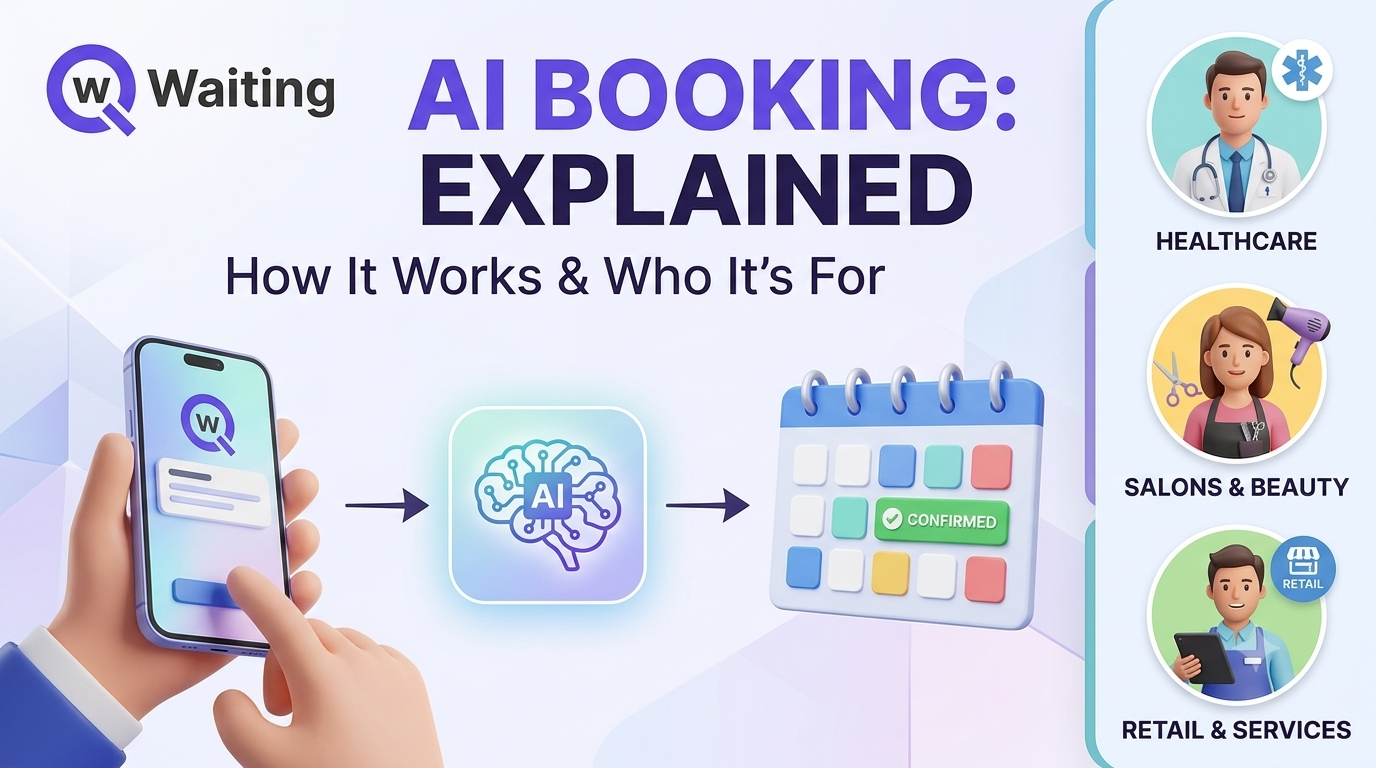
AI appointment booking automates scheduling by checking real-time availability, confirming appointments, sending reminders, and handling rescheduling across digital channels. This guide explains how AI booking works, its benefits, who can use it, and how it connects appointments with the wider customer journey.
For decades, booking an appointment meant someone juggling a phone, a calendar, and a waiting room at the same time. That held up reasonably well when volume was low. It stops holding up once demand grows, staffing stays flat, and customers expect to book at 11 p.m. from their phone rather than call during office hours the next day.
This article looks at what AI appointment booking software actually does, how it plays out across a typical customer interaction, and which organizations get genuine value from it. Not everyone needs it. The sections below should make it fairly obvious which side of that line you're on.
Worth being precise up front about what this software replaces and what it leaves alone.
Traditional scheduling runs on a person manually checking availability, holding a slot, and going back and forth by phone or email until both sides land on a time. That's manageable when an office is handling a handful of requests a day. It gets harder to sustain once the volume climbs into the dozens or hundreds, spread across multiple staff, service types, or branches.
What AI booking software changes is who does the checking. The software reads the request, checks live availability, and offers a slot directly through a chatbot, a website widget, SMS, or whatever channel the customer already prefers, without needing a person on the other end of the line to make it happen correctly. Staff time shifts toward the requests that need actual judgment: exceptions, unusual cases, complaints. The routine bookings stop eating into that time.
The capability set has become fairly standard across the category:
Understand booking requests written in natural language, not just fixed dropdown menus
Check availability across staff, service type, and location in real time
Book and reschedule appointments without staff intervention
Send confirmations and reminders automatically
Process cancellations and release the slot for someone else
Collect basic intake details before the visit
Support multiple channels: web, SMS, and WhatsApp, instead of just one
There's nothing exceptional. Each step just removes a point where a person used to have to step in.
The interaction usually starts through a website widget, a chatbot, or a messaging app. The AI reads the request and figures out what's actually being asked, whether that's a dermatology consult next week or moving a loan appointment to Friday.
The system checks that request against a live schedule instead of a spreadsheet someone updates twice a day, which is really what prevents double bookings. No one has to manually confirm a slot is still open before promising it to someone.
Business rules narrow things down from there: staff skill, service duration, and location. The customer sees real, available options immediately instead of trading three emails to find one that works.
The customer picks a slot, the system logs it against the right calendar, and a confirmation goes out right away. Nobody has to remember to send it an hour later.
Reminders follow automatically by SMS, email, or WhatsApp, and reschedule or cancellation requests get handled the same way. This is also the step doing most of the work on no-shows, which the next section gets into.
Once appointments run through one system instead of scattered calendars and notebooks, patterns start showing up:
Which days get cancelled most
Which slots are chronically overbooked
Which services are seeing rising demand
How staff utilization compares across branches
That's the point where scheduling stops being administrative overhead and starts feeding real decisions.
The mechanics explain how it works. What gets organizations to actually adopt it is what changes day to day.
Less manual scheduling work. Fewer calls and messages about availability mean staff time goes toward interactions that actually need a person.
Booking isn't tied to office hours. That matters more than it sounds for any organization serving customers across time zones or running staff in shifts.
Fewer scheduling errors. Centralized, real-time availability cuts down the classic "I thought Tuesday was free" conversation.
A smoother customer experience. Faster booking, less waiting to hear back, communication through whatever channel someone already uses.
No-shows are where things get more interesting and where it's worth being honest rather than promotional. Automated reminders and easier rescheduling do most of the heavy lifting here, and AI-driven no-show prediction, where it's supported, adds a layer on top by flagging appointments statistically more likely to be missed so staff have a reason to follow up personally.
The organizations that benefit most tend to share a few traits: real appointment volume, multiple people or locations sharing capacity, and customers who already expect a digital option.
Healthcare providers and hospitals: doctor visits, follow-ups, diagnostics, and general patient scheduling. Automating the routine bookings takes work off the front desk that can go toward patients actually in the building.
Banks and financial institutions: account consultations, loan discussions, advisory appointments. Automated scheduling takes the coordination load off branch staff who'd otherwise be fielding it by phone.
Government offices: citizen appointments, document services, licenses, and permits. Volume that's high by design, where automated booking cuts physical queuing and gives agencies a more predictable flow of visitors.
Retail and service businesses: product consultations, repairs, personal services, and support appointments. These tend to do better letting customers self-schedule rather than making everyone call in.
Education and training organizations: admissions, counselling sessions, and parent-teacher meetings, which spike around specific periods of the year, exactly where manual coordination tends to break down fastest.
The real differences show up in where the coordination burden sits, not in how much technology is involved.
Traditional scheduling isn't obsolete because of this table. It just becomes harder to justify once volume and complexity cross a certain point, and that's the actual decision most businesses are weighing, whether they frame it that way or not.
Not everything marketed as "AI scheduling" covers the same ground, so it's worth knowing what to check before signing anything.
Omnichannel booking. Customers should be able to book through the website, mobile, SMS, or WhatsApp, rather than getting funneled into whichever channel the vendor happened to build first.
Calendar and schedule integration. Real-time visibility into staff calendars, multiple locations, and different service types is what actually prevents conflicts. A booking form bolted onto a website doesn't do that on its own.
Automated reminders. Confirmations, cancellations, and reschedules should all be covered without a staff member following up by hand.
Queue and appointment management, connected. Appointment scheduling shouldn't live in a separate system from the rest of the customer's visit. A tool that doesn't connect to walk-ins, virtual queues, and on-site check-in is only solving half the problem, since most organizations handle scheduled and unscheduled customers side by side on any given day.
Analytics and reporting. Booking trends, no-shows, wait times, staff utilization. These start to matter more as volume grows past what a manager can track from memory.
Scalability across locations. For enterprises running multiple branches, a tool that can't centralize data across sites tends to create more reporting work than it saves.
Most scheduling tools stop at the calendar. What happens on the actual day of the appointment is a separate question, and it's usually the one the customer cares about most.
Qwaiting does not treat appointment booking with AI as an independent process; rather, it sees appointment booking within the context of a wider journey. Appointments are integrated with virtual queues, on-site queue management, kiosks, and customer messaging, and thus the appointment booking process becomes the first stage of the journey.
In practice, that means customers aren't forced into one way of engaging:
Some want to book ahead of time
Others prefer to join a virtual queue on the day and wait wherever suits them
Others walk in and use self-service kiosks to check in without needing staff at all
Having all these options open and linked with each other using SMS and WhatsApp notifications makes it possible not to force a particular behavior on everyone.
On top of that, it affects how much information the data will give you. Having all four aspects – booking, arrival, queuing, and service completion – on the same platform allows spotting trends related to demand, waiting time, and service load that simply aren't available with appointment scheduling alone. How does this work in practice? It starts with the customer booking a slot, arriving, being automatically enrolled into the proper queue or sent to the self-service kiosk, getting their service done, and having the entire visit logged as a single journey rather than a series of events.
This mostly comes down to volume and complexity, not industry.
Staff spend a real chunk of the day managing bookings by phone or email
Customers regularly call just to check availability
Slots get missed or double-booked with some regularity
Rescheduling creates genuine operational disruption
Multiple locations or teams share the same appointment capacity
Customers already expect a digital, after-hours booking option
Appointment volume is genuinely low
The setup is simple: one service, one staff member
There's little customer demand for digital self-service
That second list is a legitimate answer too. Matching the tool to actual volume matters more than adopting technology because it exists.
Scheduling software is drifting toward something bigger than filling calendar slots.
Demand forecasting ahead of reactive scheduling. AI-fueled demand forecasts are now being used for capacity planning and staffing planning before the customer has even made a booking.
More personalized experiences for customers. Reminders and communications are becoming more context-sensitive by adapting their tone, timing, and mode of delivery based on past behavior.
Appointment booking and queue management are converging. The future of this category isn't just about confirming a booking. It means managing the entire customer experience from their first visit to the completion of the service as a singular experience.
AI appointment booking is about more than automating calendar entries. The value sits in the full sequence: request, availability check, booking, reminders, arrival, service, and whatever the data shows afterward. Getting one step right doesn't help much if the rest of the journey still runs on manual coordination.
The right solution should improve operational efficiency and the customer's actual experience at the same time, not one at the expense of the other. Ready to move beyond basic appointment scheduling? Explore how Qwaiting's queue management platform connects appointments, virtual queues, self-service, and customer notifications into one customer journey, instead of treating booking as a task that ends the moment the calendar entry gets made.