



Deliver fast, reliable service with a cloud system that updates in real-time and scales with your business.

Control your data and infrastructure with a secure, offline-ready solution tailored for complex environments.

Empower customers to check in, book, or update their appointments without staff assistance.

Deliver fast, secure access for repeat visitors using AI-powered facial recognition.
 Banking
Streamline customer flow and reduce wait times in banks and financial institutions.
 Healthcare
Refine patient check-ins and improve healthcare service.
 Public
Sector
Public
Sector
Manage citizen services smoothly in government offices and public institutions.
 Retail
Improve shopping experiences by minimizing checkout lines and wait times.
 DMV
DMV
Organize customer service queues in automotive showrooms and service centers.
 Airport
Speed up passenger processing with efficient queue management at terminals.
All Industries → AI Appointment Booking System
Automate appointment scheduling with AI-powered booking, smart reminders, and seamless customer check-ins.
 Appointment
Booking
Appointment
Booking
Offer flexible scheduling that helps customers plan their visit and avoid peak-time congestion.
 Biometric
System
Biometric
System
Speed up identity verification and check-ins using facial or fingerprint recognition.
 Automation
Automate workflows and reduce manual tasks with smart queue solutions.
 Virtual
Queuing
Virtual
Queuing
Let customers wait from anywhere home, car, or cafe with mobile-based virtual queues.
 Visitor
Management
Visitor
Management
Track and manage visitor entry, exit, and ID verification from a single dashboard.
 Video
Queue
Video
Queue
Allow people to join video calls instantly with one link—no apps, Accessible on any browser.
 Tele-Consultation
Offer seamless virtual consultations with real-time communication tool.
All Solutions →
Explainer
Videos
Watch quick product demos and tutorials to understand how Qwaiting works for your business.
 Blog
Blog
Read expert insights, tips, and industry trends to enhance customer experience.
 Ebooks
Download in-depth guides and resources to explore queue management best practices.
 Self Guided
Demo
Self Guided
Demo
Explore Qwaiting in a quick interactive demo, no signup needed.
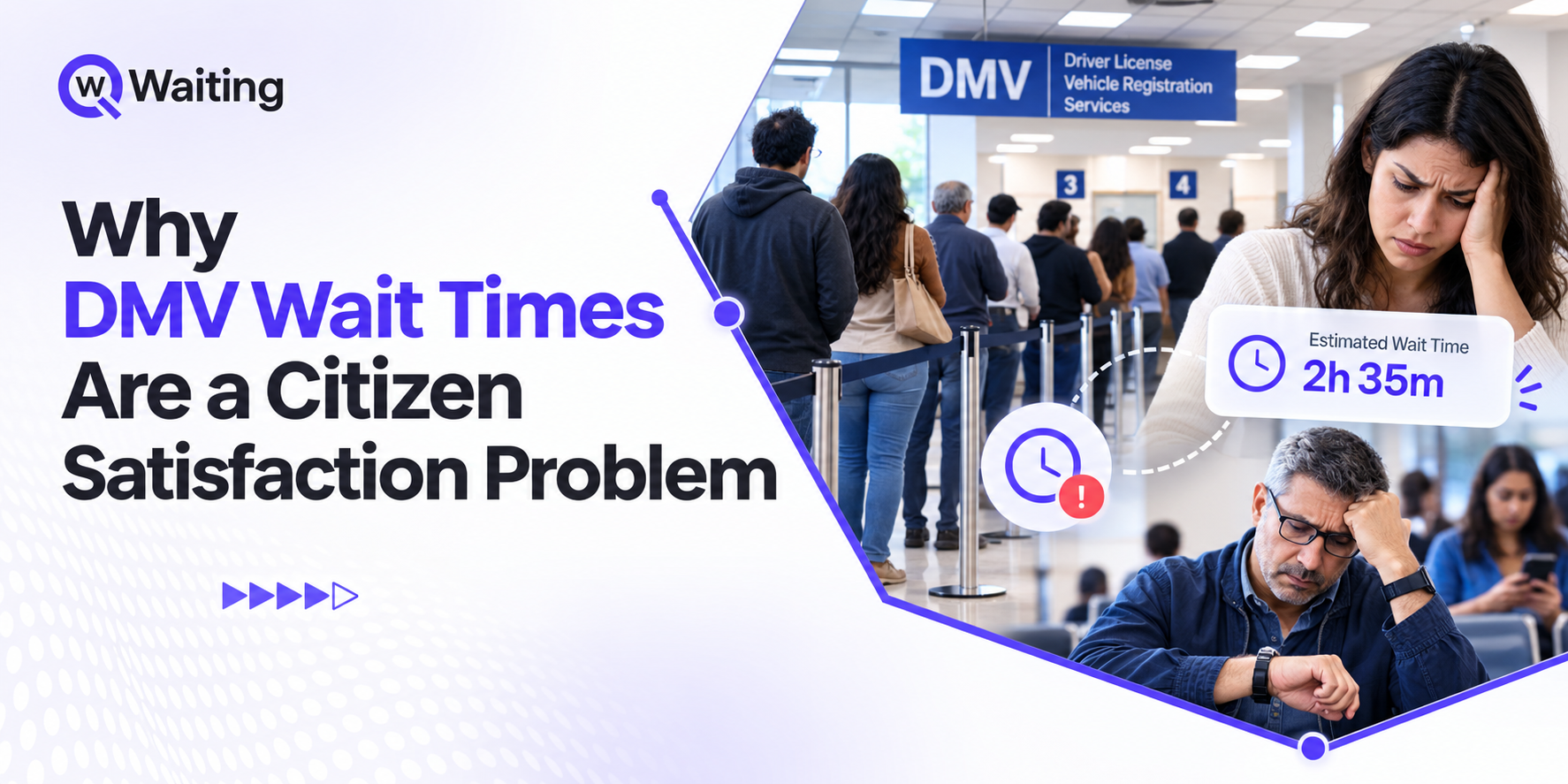
Long DMV wait times affect more than operational efficiency—they can shape how citizens perceive government services. Unpredictable queues, limited visibility, complex services, and physical waiting create frustration for both citizens and staff. Modern queue management solutions such as virtual queues, appointments, real-time notifications, self-service kiosks, and analytics can make DMV visits more predictable, efficient, and citizen-friendly.
Walk into most DMV offices on a Monday morning and you'll see the same scene: a packed waiting room, a paper ticket with a number nobody can quite match to the wall display, and citizens checking their phones every few minutes wondering if they've missed their turn. Some have taken a half-day off work for a fifteen-minute transaction. Others are standing with kids who should be in school or parents who shouldn't be on their feet that long. It's tempting to treat this as an unavoidable cost of running a public service that serves everyone. But DMV wait times aren't just an operational inconvenience that citizens tolerate and forget. They shape how people feel about the agency, the staff they interact with, and government service delivery more broadly. A citizen who spends two hours waiting to renew a license doesn't walk out thinking, "Well, the transaction itself went fine." They walk out remembering the wait. This is why more DMVs and motor vehicle agencies are rethinking the physical line altogether. Digital and virtual queue management systems are replacing the traditional take-a-number approach, giving agencies a way to reduce DMV lines while giving citizens a service experience that feels less like a test of patience and more like something designed with them in mind. Long lines rarely trace back to one cause. Usually it's three or four structural problems stacking on top of each other. DMV traffic isn't steady, and pretending it is causes most of the trouble downstream. Mornings and late afternoons spike as people route trips around work. Renewal deadlines create seasonal surges that show up on the calendar every year and somehow still catch offices off guard. And then there's the demand nobody plans for — a policy change, a new ID requirement, a system outage elsewhere that pushes people back into physical branches all at once. Most traditional lines give citizens almost nothing to go on. Take a number, wait, hope. There's no real sense of position, no reliable estimate, nothing to check against. Staff often have the same blind spot from the other side of the counter — without real-time visibility into volume and service demand, there's no good way to shift resources or give someone an honest answer when they ask how long it'll be. A license renewal and a road test are not the same transaction, and treating them like they are is where a lot of bottlenecks start. Driver licensing, vehicle registration, renewals, testing, ID services, specialized cases — each needs a different amount of staff time and different expertise. Put them all in one undifferentiated line, and a citizen with a two-minute renewal ends up stuck behind someone whose case genuinely needs twenty. Routing by service type rather than strict arrival order is one of the more underused ways to cut average wait time without hiring a single additional person. Physical lines don't flex. They can't absorb a sudden demand spike, they don't shrink on a slow Tuesday, and they require citizens to physically plant themselves on-site even when their specific service isn't close to ready. On top of that, a paper-based queue generates almost no usable data. There's no clean way to look back later and see which hours or transaction types are actually driving the backups — most of that knowledge lives in a manager's memory instead of a report. Satisfaction isn't purely a function of minutes. It's shaped just as much by predictability and communication as by the length of the wait. A visit can end in a flawless transaction and still leave someone annoyed, because the wait beforehand becomes the dominant memory of the whole trip. Agencies sometimes pour improvement budget into counter training and staff scripts while the actual satisfaction driver, the hour spent standing beforehand, goes untouched. There's a real difference between waiting thirty minutes and not knowing how long you'll be waiting. Oddly, the predictable thirty minutes is often the easier one to sit through. Uncertainty produces its own separate stress — did I miss my number, is the line even moving, should I just leave and come back tomorrow. A rough real-time estimate, even an imperfect one, changes how the entire wait feels, which is a strange but well-documented quirk of how people experience time. When citizens can't see where they stand, they ask a staff member. Multiply that by every visitor in the room and you get a very specific kind of friction: The same "how much longer" question, asked over and over, to whoever's nearest Confusion about which window or counter to approach Missed turns, followed by arguments about who was actually next Frustration landing squarely on frontline employees who have zero control over the wait itself This wears staff down in a way that doesn't show up on any performance review, and it pulls attention away from the part of the job that actually matters — serving the person in front of them. A numbered ticket dispenser solved a real problem, decades ago. It's not solving the problems DMVs are dealing with now. Standing in a physical line means staying put for the whole wait. No errand, no sitting in the car with the AC on, no stepping outside for air without risking the spot entirely. Citizens can't fit the wait around anything else in their day, and that inflexibility alone is enough to turn a routine errand into something people dread. Paper tickets and sign-in sheets tell you almost nothing about what happened yesterday, let alone what's coming next week. Leaders working off this kind of system are usually flying blind on peak periods, guessing at staff allocation, missing visibility into which counters or transaction types are actually underperforming, and unable to catch a recurring bottleneck before it's been a problem for months. The real shift is moving past basic numbering entirely. A modern DMV queue management system connects appointments, walk-ins, virtual queues, notifications, self-service check-in, and analytics into one operational picture. Framed that way, queue management stops being about managing a line and starts being about managing the whole citizen journey — from the moment someone realizes they need a service to the moment they walk out with it done. Cutting DMV lines isn't really about processing people faster at the window. It's about controlling how, when, and where the waiting happens in the first place — most of it doesn't need to happen in the building at all. A virtual queue management system lets citizens join remotely, well before they set foot in the office. Instead of standing in a physical line from the moment they arrive, they wait wherever actually works — the car, the office, home — and show up closer to when their turn comes around. That one change removes a surprising amount of unnecessary physical waiting and hands citizens back something they never had before: control over their own time. Few DMVs get the luxury of appointment-only service. Walk-ins aren't going away. A system that manages scheduled appointments and walk-ins together, balancing both across available counters, avoids the common failure mode where a fully booked appointment calendar leaves walk-in citizens waiting far longer than they should. It also cuts down the congestion that builds when arrivals go completely unmanaged. Uncertainty drives more frustration than the wait itself, and it's also the easier problem to fix. SMS and other messaging channels can push queue position updates, turn notifications, service reminders, and alerts telling someone exactly when to head back in. None of it shortens the actual clock time. All of it removes the anxiety that makes the wait feel longer than it is. Not every DMV interaction needs a person behind a counter. Routing eligible citizens toward self-service kiosks for check-in, document verification, or straightforward renewals takes pressure off staffed windows and frees employees for the transactions that actually need human judgment. None of this works without visibility underneath it. Tracking average wait time, service time, queue volume, peak demand periods, counter-level performance, and staff utilization gives leaders something to act on before a bottleneck becomes chronic, instead of only hearing about it through complaints. A better DMV experience isn't one fix. It's the full sequence a citizen actually moves through — before, during, and after the visit. Before the visit: they find the service they need, then book an appointment or join a virtual queue instead of defaulting to standing in line. While waiting: they get an estimated wait time, a notification as their turn nears, and skip most of the physical standing-around entirely. At the DMV: they check in, get directed to the right window based on what they actually need, and get served without wandering around confused. After the visit: the transaction wraps up, feedback gets captured, and the operational data feeds back into better staffing and planning for the next surge. Seen this way, queue management was never really about the line. It's about the journey around the line, and most of that journey happens away from the counter entirely. Fixing DMV wait times takes a platform built around the whole citizen journey, not a faster version of the same ticket dispenser. Qwaiting brings virtual and on-site queues into a single system, so staff aren't juggling two disconnected processes. Digital activity and in-person flow land in the same operational view, giving leaders one picture of demand instead of two partial ones. Virtual queuing, appointment scheduling, digital notifications, and real-time updates hand citizens more say over how they spend their time. Nobody's required to plant themselves in a physical line the second they arrive. Real-time dashboards, queue analytics, service performance visibility, and staffing insights give leaders decisions based on what's actually happening on the floor, not on what a manager happened to notice while walking past. Queue management, appointment scheduling, self-service kiosks, digital signage, SMS and WhatsApp notifications, and analytics function as one connected system instead of separate tools bolted together after the fact. That's the real distinction between Qwaiting and a digital version of a paper ticket dispenser — it's built as a citizen journey platform, not just a queue counter with a screen attached. A lot of agencies solve the ticketing problem without ever touching the journey problem underneath it. Shorter lines are a good outcome. They're not the whole point. Transparency about estimated wait times and real-time updates matters as much as the length of the wait itself. A predictable forty-minute wait, clearly communicated, tends to beat a shorter but confusing one almost every time. Better resource allocation, smarter routing by transaction type, and less congestion at peak hours compound over time — more capacity without necessarily adding staff or counters. Fewer pointless physical queues, easier access to services, clearer communication throughout. None of it sounds dramatic on its own. Together, it's the difference between an office people dread and one they don't think twice about. DMV wait times were never just a scheduling issue or a staffing issue. They're a direct input into how citizens judge public service delivery, and that judgment tends to outlast the specific transaction that caused it. Modernizing DMV operations isn't really about moving people through faster. It's about making the whole experience more predictable, more accessible, and easier to plan a day around. These agencies are not only concerned about how to push the line forward faster. They're asking a better question: why does a citizen need to stand in a physical line at all, for a transaction that could be managed remotely, tracked digitally, and finished in a fraction of the time? Relying on physical queues for handling demands from citizens? Find out how a queue management system at the DMV can help your agency shift from line management to citizen connection. For a closer look at implementation, how online queuing systems benefit government agencies is worth reading next.What Causes Long DMV Wait Times?
Uneven Demand Throughout the Day
Limited Visibility Into the Queue
Complex DMV Services Take Different Amounts of Time
Traditional First-Come, First-Served Queues Are Difficult to Scale
How DMV Wait Times Affect Citizen Satisfaction
Long Waits Can Overshadow Good Service
Uncertainty Can Be Worse Than the Wait Itself
Poor Queue Experiences Can Increase Staff-Citizen Friction
Why Traditional DMV Queue Systems Are No Longer Enough
Physical Lines Don't Give Citizens Control
Manual Queue Management Gives Leaders Limited Data
A Modern DMV Needs More Than a Ticket Dispenser
How a DMV Queue Management System Can Reduce DMV Lines
Let Citizens Join a Virtual Queue
Combine Appointments and Walk-In Visitors
Keep Citizens Updated With Real-Time Notifications
Use Self-Service to Handle Simple Transactions
Use Analytics to Identify Bottlenecks
What a Better DMV Citizen Journey Looks Like
Qwaiting: A Smarter Approach to DMV Queue Management
Manage Virtual and Physical Queues From One Platform
Give Citizens More Freedom Over Their Waiting Time
Help DMV Teams Make Better Operational Decisions
Build a More Connected Citizen Service Experience
The Goal Isn't Just Shorter DMV Lines
Make Waiting More Predictable
Make DMV Operations More Efficient
Make the Citizen Experience Less Frustrating
Final Thoughts
