


Deliver fast, reliable service with a cloud system that updates in real-time and scales with your business.

Control your data and infrastructure with a secure, offline-ready solution tailored for complex environments.

Empower customers to check in, book, or update their appointments without staff assistance.

Deliver fast, secure access for repeat visitors using AI-powered facial recognition.
 Banking
Streamline customer flow and reduce wait times in banks and financial institutions.
 Healthcare
Refine patient check-ins and improve healthcare service.
 Public
Sector
Public
Sector
Manage citizen services smoothly in government offices and public institutions.
 Retail
Improve shopping experiences by minimizing checkout lines and wait times.
 DMV
DMV
Organize customer service queues in automotive showrooms and service centers.
 Airport
Speed up passenger processing with efficient queue management at terminals.
All Industries → AI Appointment Booking System
Automate appointment scheduling with AI-powered booking, smart reminders, and seamless customer check-ins.
 Appointment
Booking
Appointment
Booking
Offer flexible scheduling that helps customers plan their visit and avoid peak-time congestion.
 Biometric
System
Biometric
System
Speed up identity verification and check-ins using facial or fingerprint recognition.
 Automation
Automate workflows and reduce manual tasks with smart queue solutions.
 Virtual
Queuing
Virtual
Queuing
Let customers wait from anywhere home, car, or cafe with mobile-based virtual queues.
 Visitor
Management
Visitor
Management
Track and manage visitor entry, exit, and ID verification from a single dashboard.
 Video
Queue
Video
Queue
Allow people to join video calls instantly with one link—no apps, Accessible on any browser.
 Tele-Consultation
Offer seamless virtual consultations with real-time communication tool.
All Solutions →
Watch quick product demos and tutorials to understand how Qwaiting works for your business.

Read expert insights, tips, and industry trends to enhance customer experience.

Download in-depth guides and resources to explore queue management best practices.

Explore Qwaiting in a quick interactive demo, no signup needed.
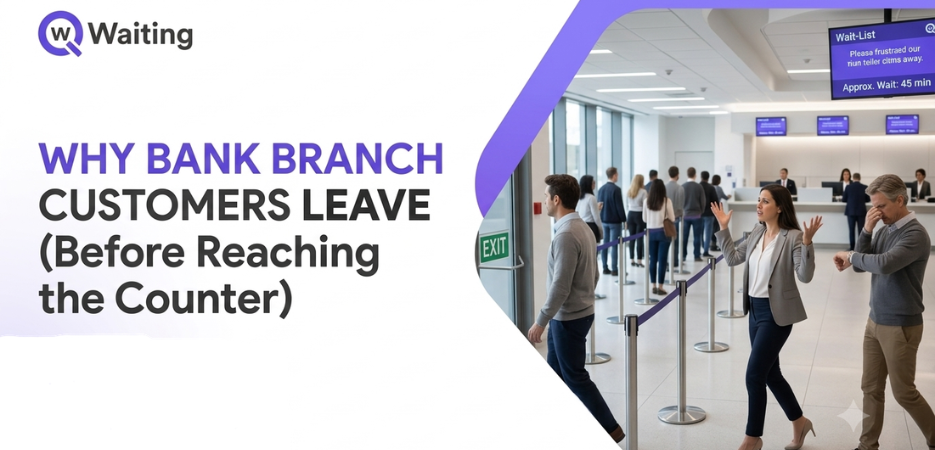
Long queues can cause bank customers to leave before they ever reach the counter, resulting in missed transactions, lost cross-selling opportunities, and lower customer loyalty. Modern bank branch queue management helps banks understand customer flow, reduce bottlenecks, improve wait-time visibility, and give customers more flexibility through virtual queues, appointments, and real-time notifications. This guide explores why customers walk away and how smarter queue management can create a more predictable and efficient branch experience.
Somewhere between taking a number and reaching the counter, some bank customers quietly give up. They don't complain to a teller. They don't fill out a feedback form. They just leave. Unless someone notices the empty spot in the line, the branch never even knows it happened.
That's the real cost of long queues. It isn't measured in complaints, because most walkaways never create one. It shows up later instead. A missed transaction. A product the customer never heard about. A relationship that slowly drifts to a competitor. Yet very few branches track it with any consistency.
Adding more counters or hiring more staff is the usual fix. It's also often the most expensive one. Modern bank branch queue management works differently. It looks at how customers actually move through a branch. It finds where the real bottlenecks form.
In the following article, we will uncover how modern tools and technology can help bank branches, either one or multiple, provide seamless services to their customers.
Before fixing walkaways, it helps to know what causes them. Four patterns show up again and again in branch environments.
A ten-minute wait feels fine when a customer knows it's ten minutes. Ten minutes seems to be a lot of time if no one can tell you whether it is five or twenty-five more minutes. This anxiety, rather than waiting itself, drives people to the door.
A physical line asks customers to stand in one spot and stay there. To step out for an incoming call or a drink of coffee would mean giving up their space. No one would like to take that chance. So they either stand and wait, or they leave. Virtual queuing removes the trade-off. Customers hold their spot digitally. They only need to show up when their turn is close.
Lunch hours, paydays, and end-of-the-month times concentrate the pressure in very limited time frames. A branch operating smoothly on Tuesday may have a totally different atmosphere by Friday afternoon. With staff allocated on an average day rather than a busy day, a queuing issue becomes a customer service issue in no time.
Mobile banking has reset what customers see as reasonable. Transfers happen in seconds. Balances update instantly. Most routine requests never need a branch visit at all. So when someone does walk into a branch, they bring those same expectations with them, whether the branch is ready for it or not.
A walkaway rarely ends at the door. It moves upstream into revenue, loyalty, and the reports a bank uses to judge branch performance.
A customer who leaves without being served may not come back that day. Maybe not that week either. The bank also loses something less obvious. A teller might have mentioned a savings account, a card upgrade, or a loan the customer hadn't considered. Those conversations mostly happen face to face. A walkaway removes the chance completely.
One long wait rarely changes how a customer feels about a bank. Several long waits do. Over time, the waiting experience becomes part of how customers describe the bank itself, not just the branch. That impression follows them into every other channel, including the ones the bank spent good money making feel effortless.
Most branch reports track transaction volume, service time, and staffing hours. Few track how many customers entered a queue and never reached a counter. That's a gap worth closing. A rising customer walkaway rate banking metric often signals trouble long before it shows up in satisfaction surveys or closed accounts. It catches dissatisfaction the moment it happens, not weeks later.
How Can Banks Reduce Banking Wait Times Without Adding More Counters?
Cutting wait times doesn't have to mean bigger branches or bigger budgets. It usually starts with seeing how customers actually move.
Arrival patterns, service times, and queue length tell a truer story than guesswork. A branch might assume its bottleneck sits at the teller counter. The real delay might actually happen during account opening, or in one specific hour that staffing doesn't cover. Data settles the question. Assumptions don't.
Not every request needs the same counter or the same amount of time. A quick balance inquiry is not a complex loan application. Send each to the right desk, and simple transactions stop getting stuck behind long ones.
A digital queue number with an estimated wait time changes how a customer experiences that same stretch of time. It replaces guesswork with a plan. And a customer with a plan is far less likely to walk out.
Letting customers join a queue from a phone or a kiosk removes the need to stand in one place for the entire wait. Virtual queue management also eases physical crowding inside the branch. That matters for comfort, and it matters for staff visibility during busy periods.
Branch queue software turns an unmanaged line into a system with structure, data, and communication built in.
Customers join a queue through a kiosk, a mobile device, or a QR code at the entrance. There's no need to stand in a physical line from the moment they arrive.
Once registered, customers get sent to the right desk based on what they actually need, not simply who arrived first. This helps branches balance workload across counters. One desk stops overflowing while another sits idle.
Branch managers get a live view of queue length, wait times, and counter activity. That visibility helps them catch a building bottleneck early, while it's still fixable. Not after it has already cost the branch several walkaways.
SMS and messaging alerts tell customers when their turn is close. They don't have to sit inside the branch for the entire wait. It's a small change with a big effect on how the wait actually feels.
The gains here go beyond a shorter number on a monthly report.
Both the actual wait and the felt wait shrink when customers get visibility and flexibility. And the felt wait is usually what customers remember, and repeat to others.
Knowing roughly where they stand in a queue lets customers plan the rest of their day around a bank visit, instead of the other way around.
When managers can see demand building in real time, they can shift staff toward the counters that need it. No more reacting after a queue has already backed up.
A queue system that adjusts to real volume works differently. It handles a slow Tuesday and a chaotic Friday with the same basic setup, rather than one built only for an average day.
For banks working through these challenges, Qwaiting treats the branch as one connected customer journey, not a row of separate counters.
Qwaiting's banking queue management system brings walk-in traffic, virtual queues, and appointments into a single view. Branch managers aren't stuck juggling separate systems for each type of customer.
Customers can register for a queue before they even arrive, then spend their waiting time elsewhere. That directly supports lower customer walkaway rates, because it removes the exact moment where frustration usually builds.
Alerts sent at the right moment cut down the uncertainty that makes waiting feel longer than it is. Customers can run other errands instead of hovering near the entrance.
Waiting times, service times, and customer volumes turn into a record branch managers can actually act on. Not just a set of numbers nobody has time to review.
Queue management, appointment scheduling, self-service check-in, and notifications work as one journey here, not separate tools bolted together. That's closer to how customers actually experience a branch visit.
Some of these need new technology. Others just need attention paid to data a branch may already have.
Analyze peak customer arrival times. Know which hours and days pile up demand before deciding where to add capacity.
Offer virtual queueing. Let customers hold their place remotely instead of standing in the branch for the entire wait.
Introduce self-service options. Move routine check-ins and simple requests away from staffed counters.
Use appointment scheduling for complex services. Save counter time for loan talks and account changes that genuinely need it.
Send real-time queue notifications. Replace uncertainty with a clear signal of when a customer's turn is close.
Monitor service times. Track how long each type of transaction actually takes, not just how many happen per day.
Act on queue analytics. Data that sits unused doesn't reduce walkaways. Reviewing it, and adjusting staffing or routing in response, does.
Where branch banking is headed says almost as much about walkaway rates as anything happening today.
Physical branches aren't disappearing. But their role is shifting, from handling every transaction to handling the ones that genuinely need a human conversation.
Some branches will predict demand before it arrives. Others will keep reacting to a queue that has already formed. That gap will separate branches that manage flow well from the ones that don't.
Self-service will likely handle routine requests. Staff will handle the complex ones. Queue technology becomes the layer connecting the two, so customers move between them without friction.
A long queue is an operational problem and a retention problem, at the same time. Most branches only measure the first one. Knowing where customers wait, why they wait, and when they give up matters. It's the difference between guessing at branch performance and actually managing it.
Bank branch queue management isn't about making a line move faster for its own sake. It's about building a branch visit that feels predictable and gives customers real control. One that never forces them to choose between waiting forever and walking out.
How many customers is your bank losing simply because they don't want to wait?
Still relying on physical lines to manage branch demand? Qwaiting's banking queue management system connects walk-in queues, appointments, and real-time notifications into one branch experience. It's built to cut down the moments that turn into walkaways.